Author: Ingrid Lewis
This is a presentation given at a webinar for GIZ Jordan, July 2020.
What is this presentation about?
Inclusive education is not just about schools. Genuinely inclusive education systems look at a continuum of learning experiences and support, from home and community, to non-formal settings, through to formal education institutions. Often, inclusive education programmes focus narrowly on schools. The Covid-19 crisis reminds us that education is – and has to be – about much more than the formal school system. In this presentation I’ll share some thoughts on how to position home learning in the discussions on rebuilding and improving education systems.
How did we get here?
When Covid-19 caused schools around the world to close, it was hard to predict the full implications – for learners, their families and communities, and for education systems and countries as a whole. The speed, complexity and rigour of government responses and reach varied massively, even within countries.
In many countries, schools are now re-opening, often in phases, such as exam-year students returning first. Some have decided not to re-open this year. Some are attempting to follow social distancing rules, such as limiting the numbers of children allowed in classrooms, and breaking classes into smaller groups who attend at different times or on different days. Thousands of schools around the world are asking: how can we stay safe with 60+ children per class and no water for handwashing?
Re-opening schools presents multiple challenges:
- how to help learners ‘catch up’ with months of missed education;
- how to teach classes of learners who are now probably more academically diverse than ever;
- how to deal with the ongoing absence of many learners, because of their own or other family members’ health or vulnerability;
- the inevitable growth in drop-out rates where families need or want their children to work or get married instead of returning to school;
- the ever-present risk that the pandemic will force schools and society to shut down again.
While it feels wrong to talk about positives in a situation that has been devastating for so many people, I do want us to think about the potential positive inclusion-oriented opportunities that now exist.
Lessons from the home learning experience
EENET believes that to develop an inclusive education system, we need to be reflective and critical – learn from every experience; think how we could do better next time; and listen to colleagues, learners, families and communities.
To rebuild and reform education systems now, we must reflect critically on the experiences of home learning during Covid-19. What can we learn that will help us move forward with a more inclusive, higher quality education system?
There are various clear messages emerging from this experience – I’m focusing on just a few that feel particularly relevant to inclusive education.
- Persistent interpretations (mis-interpretations) of what education is undermine inclusivity.
The crisis highlighted in many places the obsession with seeing education only as a highly academic, exam-driven process.
EENET’s rapid global survey revealed that parents, caregivers and family members in diverse countries felt under immense pressure to maintain high standards of academic learning at home. Sometimes this pressure came from the government, schools and teachers who provided complex instructions for how parents could – overnight – become multi-subject, multi-grade teachers. Sometimes the pressure came from friends, neighbours or from parents themselves – like it was a competition to see whose child would be furthest ahead when schools re-opened.
Such pressure probably emerged because a pressurised academic system is all that most people have ever experienced in their life – so they had nothing else to use as a template for planning learning at home.
- Equality in learning is not just about equal access to school.
Many families and learners have been overwhelmed by the quantity of online learning materials available, and many more have been demoralised by having no access to any such materials. Families have felt despair because they could not offer the time, support, or materials they wanted for their children whilst learning at home. Such inequality of learning opportunities and support of course happened all the time before the crisis, but this really hit the spotlight when schools closed.
- Education systems do not provide what learners really need in order to participate and learn.
Many crisis responses – from government and non-government sources – focused on advising parents how to teach every topic in the curriculum, how to make a timetable covering every subject, how to motivate children to learn all day. Worryingly there was even a growing discourse on how parents could assess and grade their children’s work. This followed the established school-based exam-oriented formula, but arguably was not what most learners (or their families) actually needed during this crisis.
By contrast, we were encouraged by examples of innovations from some teachers, families and learners who rejected high-pressure academic expectations and chose to ‘go with the flow’ – throwing away timetables and curricula and responding flexibly and spontaneously to what was happening in the home and to how families and children were feeling each day. This is the kind of flexibility that characterises inclusive education; the kind of flexibility that the formal education system in many contexts did not offer during this crisis.
- To build an inclusive education system we must acknowledge that the system is the problem, not the child.
This is a key concept in inclusive education. It is not the child’s fault they struggle to learn, but the teacher’s responsibility to teach better or the curriculum developer’s responsibility to create a more accessible and flexible curriculum, and so on. Throughout the crisis a lot of discussion has focused on how education systems can help children – especially the most marginalised – ‘stay on track’ with the expected learning programme at home, or get ‘back on track’ when schools re-open. This discourse seems rooted in ‘child-as-problem’ thinking – based on an assumption that the system will be the same when schools re-open and the child will have to do something special to keep up or catch up.
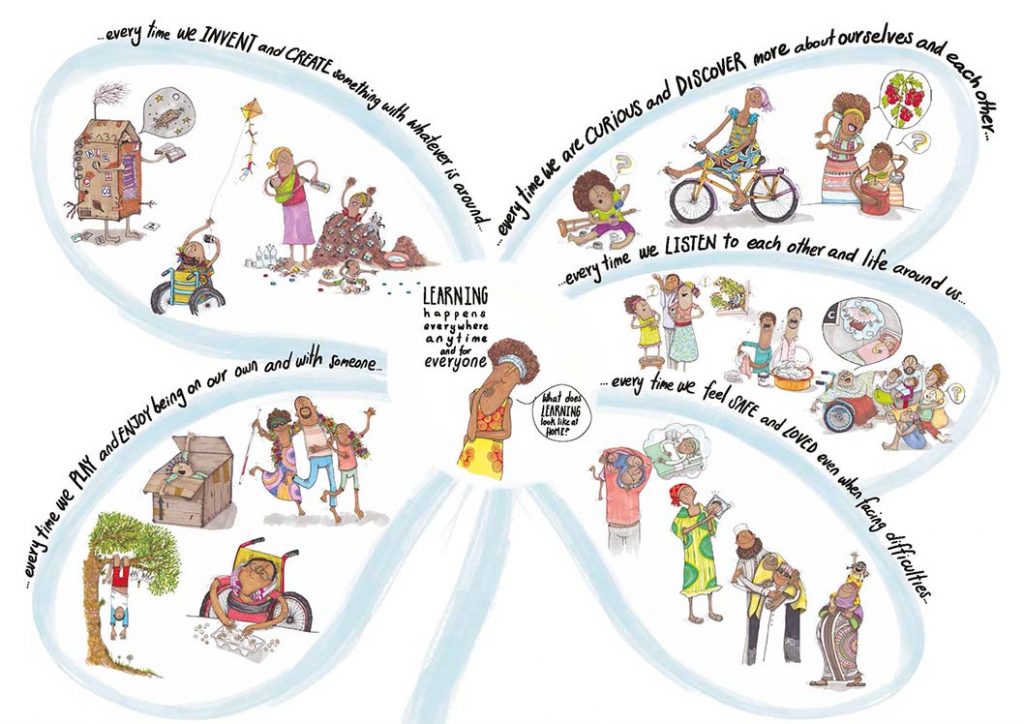
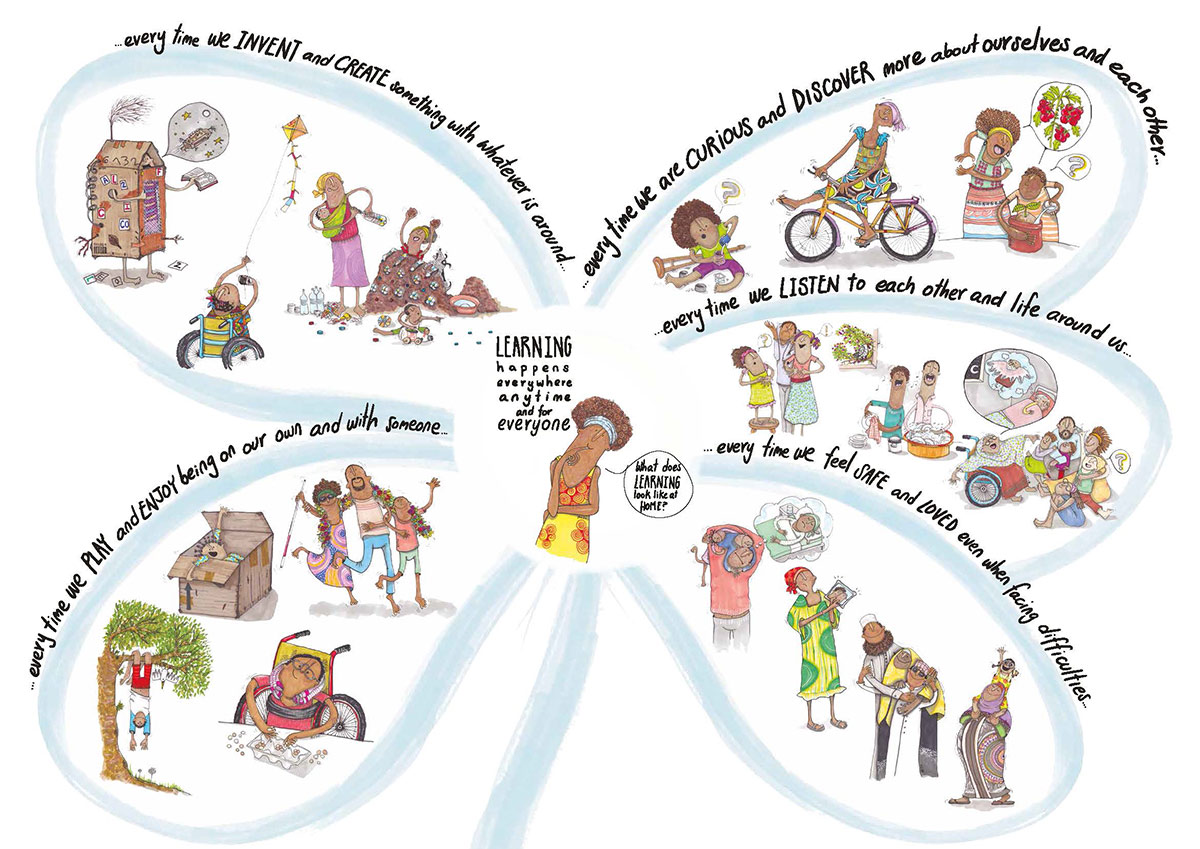
In developing our own response, EENET (through its partnership with Norwegian Association of Disabled) chose to offer families simple accessible materials that prioritise family and learner mental wellbeing whilst highlighting accessible learning opportunities available in day-to-day life. Our message was “everything you are already doing at home can be a relaxed and fun learning opportunity. Use what you have in the home and community, use what feels comfortable right now, use what interests you. Value real-life learning and skills-building not just information retention.”
Building inclusive education systems that value the home learning experience
Of course EENET’s response was not unique. Around the world many individuals and groups have promoted similar responses. But the big question is, to what extent will education systems endorse such messages? Will they value the real-life lessons children have learned during lockdown? Will they recognise the importance of the social, physical, intellectual, communication and emotional skills that learners have developed through their home learning experiences, if such skills and competencies are not measured through the existing exam system? When schools re-open, will education systems want ‘business as usual’ as fast as possible, or will they embrace change and do what the learners really need?
If education systems stick rigidly to pre-crisis ways of organising, facilitating and examining learning, they will build a barrier to millions of children who did not – and had no possible chance to – ‘keep up’ during school closures, or who cannot now return to school as quickly or regularly as their peers, due to health or other reasons.
‘Building back better’ after Covid-19 has to involve developing an education system that values a much wider interpretation of what learning, competency and skills development is about, and that responds to the individual child’s needs instead of expecting the child to keep up, catch up, or adapt in some other way.
Education systems have to recognise the learning that happened in homes and acknowledge that what families achieved has real value and contributes positively to children’s education and futures. As schools re-open, millions of parents and caregivers feel nervous about what is going to happen to their children. They don’t just fear for their children’s safety at school, they are scared that their children will now fail and that everything they as parents tried to do during lockdown will be considered wrong or inadequate by teachers and officials.
The best way now to say “actually we do value your home learning experiences” would be to work on properly embedding learning at home into the education system. By this I certainly do not mean we should dump more work and responsibility on parents or exclude more learners from school!! I simply mean we need to focus on the idea that an inclusive education system is a continuum of learning – from birth and home, through community-based informal learning opportunities, through to more structured non-formal learning and formal school-based learning.
Given that for months learning was a home and community-based process, we now need to ask how schools and the curriculum can more effectively connect with the community and learners’ home lives.
Why bother?
Why should we radically redesign the education system when we could just treat the home learning period as an unfortunate blip in history and return to normal as fast as possible?
For a start, the crisis is not over yet. Schools are not all open full time, for all year groups, and in some places the need for social distancing and quarantine will keep many children out of school for months to come. Home learning is not history yet.
Sometimes big changes only happen after a crisis. A crisis gives us an opportunity that socially, economically or politically might not have been possible before.
But home learning is not just something that is necessary as a crisis response. At all ages, children learn huge amounts at home and in the family and community. Some children rely more than others on opportunities to learn at home, such as children with disabilities, chronic health conditions, behavioural challenges, mental ill-health, children living in poverty or remote places, etc – all of whom may start school late or be unable to attend as much as their peers. If we had a system that valued learning at home – and invested in supporting home and community-based learning opportunities – imagine how many more children could benefit from education. I do not mean as an alternative to attending mainstream schools, but as an extra option on a continuum of flexible learning opportunities.
Crises like Covid-19 are predicted to become more frequent. We owe it to future generations to become better prepared. If we have education systems that value home and community-based learning, focused on real-life relevant skills development and not just school-based, academic knowledge retention, then future crises like this will be less of a shock. We’ll have mechanisms in place that can more easily be scaled up; teachers will already be used to supporting formal and informal learning in and beyond the classroom; families will be more familiar with supporting learning at home, and they’ll feel more confident that whatever support they can give is valuable to their children’s futures.
Inclusive education has never been a simple checklist of school-based actions. It’s never been as simple as building ramps in schools, providing Braille books and hearing aids, and sending teachers on a few training courses (although sadly many programmes have operated on that basis!). Inclusive education has always been about innovation, finding different ways to approach teaching and learning so that everyone joins in and benefits. The home learning experience has handed us a wealth of potential ideas to feed inclusive education innovations
How many countries will take the opportunity to learn and change, and how many will simply fall back into the old routine as quickly as possible – oblivious to the fact that ‘business as usual’ is now excluding more leaners than ever?