
The Digital Voices of the Future project team
The future of treescapes belongs to children but their voices are often missing from decision-making. Digital Voices of the Future offered meaningful ways to understand what matters to children when planning and planting treescapes. We wanted to consider whether virtual spaces could help share knowledge fairly and give children a stronger voice in shaping environmental policies, plans, and implementation.
A treescape is a landscape with many trees or groups of trees. The term treescape helps to emphasise the visual, cultural and ecological significance of the trees within the specific environment.
Young people, treescapes and Voices of the Future
Even at a young age, children show sophisticated understanding of trees and forests, often linked to climate change. Despite this, their views are rarely or only superficially included in decision-making. The Voices of the Future (VotF) project explored how integrating science and art could enable conversations about treescapes with young people. Working across sectors, VotF generated new methodologies for education, policy development, and community engagement.
The project was funded through the UK Research and Innovation’s UK Treescapes Programme. The funding spans multiple councils (local government areas) and seeks to deepen understanding of the UK’s trees and forests from environmental, social, and cultural perspectives.
Storytelling played a key role in VotF. Children imagined trees within their social lives and created personal, shared stories about treescapes. Digital Voices of the Future (DVotF) extended this approach by exploring how videogames could engage children in environmental decision making.
Digital Voices of the Future
DVotF starts from the principle that children should be empowered to create knowledge, not just receive it. We wanted to rethink what “voice” means when it comes to children, schools, research, and climate change education. This is increasingly important as education responds to the urgent need for climate action. But this was not just about teaching facts on carbon or focusing on climate science. We wanted children to play an active role in environmental research, to share ideas and be empowered in shaping solutions.
DVotF worked with children aged 9-13 at a primary and secondary school in England. They designed imaginary worlds, characters, and stories that could be the basis for games, focused on trees and treescapes. Since every child experiences trees differently, we explored how these activities shaped their ideas and views about treescapes. Using videogames offers a novel way to engage children with climate change and understand the futures they imagine for themselves. Are these futures shaped by choices about tree planting and care? We facilitated sessions, where children co-designed a videogame. We listened to their emerging stories and ideas, and how the game design process connected to their own local experiences with trees and green spaces.
Designing the game
There were five sessions in the process of co-designing video games:
- Context setting: Children learned about the project and research ethics, then designed a tree as a starting point for their game.
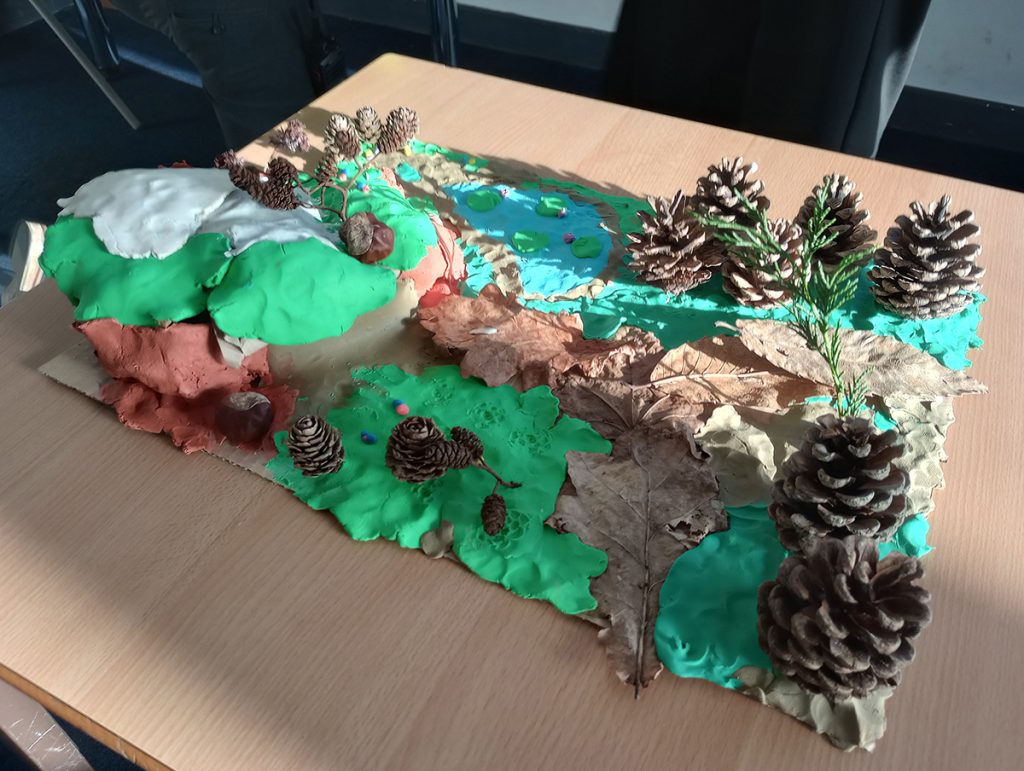
- World-building: They created 3D models of imagined game worlds using craft materials and digital tools.
- Character and narrative building: Children designed game characters, shared their stories, and filmed videos in character using masks they made.
- Tree sensing and scanning: They explored trees in their school grounds and used equipment to create 3D laser scans.
- Play testing and redesign: Children tested the game and gave feedback.
We used methodology developed by X||dinary Stories, who also created the code to turn the children’s ideas into a working video game between steps four and five. The game was further refined after the fifth session.
A sixth session was conducted outdoors and focused on the children’s relationships with trees and their connections between physical and game worlds. Their observational information helped to inform the plan for woodlands and green spaces across Merseyside and North Cheshire developed by the organisation The Mersey Forest.
Policy development
The DVotF team included staff from Mersey Forest. They joined the game design sessions to observe the children’s connections with treescapes. The children’s early ideas were imaginative – trees as characters or magical rainbow fruit trees. These encounters revealed information on how children value trees: climbing, family walks, blossom, fruit, and wildlife. As part of the wider public consultation, these insights helped shape The Mersey Forest’s vision of doing ‘More with trees’. The children’s input also influenced Mersey Forest’s 15 guiding strategic principles.
The outdoor sessions were the most revealing. The children explored treescapes near their schools, including a thicket that they had not been into before. They noticed plants, insects, light and shade. Some were excited, calling it an adventure, while others were cautious or fearful. Their observations and conversations showed how children experience nature, from curiosity and play to hesitation and discomfort, and how outdoor experiences help children notice, feel, and care about nature.
These moments helped shape The Mersey Forest Plan, highlighting that we can co-create a culture of trees and nature by weaving them into everyday life, in education, health, planning, transport, and more. The outdoor sessions also showed that schools should create more opportunities for children to play spontaneous and learn outdoors, even in small informal spaces without footpaths, to encourage learning through discovery.
Conclusions
Co-designing video games helped us have meaningful conversations with children about treescapes. Their ideas informed local plans for woodlands and green spaces. By observing children in activities like game design or play we elicited their opinion and values, giving environmental policy making and consultation a richer and more nuanced approach.
Contact
The DVotF team incudes Simon Carr (University of Cumbria), Khawla Badwan and Su Corcoran (Manchester Metropolitan University), Susannah Gill and Dave Armson (Mersey Forest), Johan Siebers (Middlesex University), Eleanor Dare and Dylan Yamada-Rice (X||Ordinary Stories).
Contact: simon.carr@cumbria.ac.uk
Treescapes projects: https://bit.ly/eer2025-2
DvotF summary: https://bit.ly/eer2025-3
DVotF project website: https://bit.ly/eer2025-4