[Podcast transcript] Assistive Tech: Starting early changes everything

This is the transcript for our episode of the Inclusive Education: Unheard Stories podcast, with Vibhu Sharma.

Listen to the podcast on Spotify.

Note: This transcript has been lightly edited for readability.

[Opening music]

Vibhu Sharma

Science is very clear: 90% of the brain development happens by the age of five. And that’s a very strong reason why introducing assistive technologies to children in early learning is critical.

Ayman Qwaider

Hello, everyone. Welcome to the Enabling Education Network podcast series, Inclusive Education: Unheard Stories.

I’m the series host Ayman Qwaider. In this series, we hear from education stakeholders about their experiences of learners who are most at risk of exclusion, marginalization and oppression and we look at ways to enable their inclusion.

I’m delighted to be joined today by Vibhu Sharma, a disability and inclusion consultant specialising in inclusive education and assistive technology with particular focus on early childhood education. Vibhu, welcome to the Unheard Stories. I’m also joined by my colleague, my EENET colleague, Ingrid Lewis. Welcome to the podcast, Vibhu and Ingrid.

Vibhu Sharma

Thanks, for having me on the podcast.

Ingrid Lewis

Thanks, I’m really looking forward to the discussions today.

Ayman

Can we start by hearing why the topic of assistive technology in inclusive education is so important to you? Maybe tell us a little bit about your journey to becoming a consultant focusing on this issue.

Vibhu

Why is assistive technology, inclusive education, early childhood education so important for me? Yeah, for me, it’s not just a professional issue. It’s very personal. I grew up relying on assistive technologies myself and I have really seen how something as simple as, you know, in my case, because I’m visually impaired, I use a screen reader.

But what that made me realise is how using something as simple as that could completely change the opportunities that you have in life. But at the same time, using assistive technology also came with stigma.

So, some classmates saw me as different. And I remember one particular instance where we had just written a test in the class. And one of my classmates walked up to me and said, “oh, you know, for you it’s so easy because…”. So because I was using the screen reader, I would sit in a separate room to write my exam, so that others didn’t hear my screen reader or they didn’t see the computer screen. And so they couldn’t copy my answers. So the classmate walked up to me with her own assumptions. And she said, “for you, it’s so easy because you sit in a computer room and write the exam so the teacher tells you all the answers”.

And then there were other instances that the classmates would really like, see me as different. But at the same time, what I do want to mention very briefly over here, is that we often think that assistive technologies are only high-end devices. I’ll elaborate more on it during the course of the conversation. But assistive technologies really don’t have to be high-tech devices. It could be something as simple as using a large print. So going back to the initial question that you had asked me, in the very initial stages, some of the teachers even that I met had issues with me using assistive technology.

So part of what drives me today in my work at the personal level is making sure that children don’t have to carry that stigma. They don’t see assistive technology as a marker of difference, or even as a luxury, but they should rather see that assistive technology is a tool that opens doors and it’s empowering for children with disability.

Ayman

That’s really awesome. Thank you so much, vibhu. I think it’s really, you sum it up very nicely, the issue that learners should not feel that stigma when using assistive technology in order to ensure that the content is accessible to them. So, as well as focusing on assistive technology, you are also passionate about inclusive early years of education, bringing the two issues together. Why do you believe assistive technology is particularly important for inclusive early years learning?

Vibhu

So as I was mentioning, assistive technology is not only about high-end devices or high-tech devices. In reality, assistive technology has to be something that enables presence, participation and achievement of children with disabilities in mainstream classrooms.

And assistive technology then could mean something as simple as a pair of glasses that we all usually use or a communication device. Or anything under the sun that makes learning accessible. So, you know, for example, we could be using bottle caps to teach children how to count. We could be using something as a large font printout that children could use to read.

So all these in essence could be assistive devices or assistive learning materials that enable children to learn. As I began working at the intersections of assistive technology, inclusive education, early years, and I’ve interacted with more and more people, I realised that there was even a bigger problem.

Science is very clear: 90% of the brain development happens by the age of five. And that’s a very strong reason why introducing assistive technologies to children in early learning is critical because if we wait until a hypothetically correct age to introduce technologies to children, we already end up losing a critical window of development in which most of the learning around socialisation, around being independent, even around being, you know, picking up on learning how to learn happens.

So what I have found is that children should be introduced to technologies as soon as they need access to information. And yet what we notice is that despite technology being available to us everywhere in our lives, assistive technologies at the moment you add adjective ‘assistive’ to technology. And it’s still rarely a part of any education plan.

So you think about a child who goes to preschool, who uses a hearing aid would be much more beneficial in comparison to us waiting until they reach an age of seven or until they reach a primary school to introduce them to that hearing aid.

Because what happens then is that the difference between social development is enormous. And often what I have also noticed that I’ve been working on these issues is that that barrier is not only in planning, it’s also political will, it’s also finance. So too often you would see that education plans would not prioritise assistive technology as I was saying earlier.

And this is also the reason why the current initiative that I’m working on, which is the Act for Early Years Campaign, is so important because the three goals that the Act for Early Years Campaign has is universal access to pre-primary and pre-school education, universal access to health care, and universal support for families and child benefit. But the question here is how are children with disabilities then going to get universal access to pre-school unless they don’t get access to assistive technologies, which is what they essentially need to access pre-school.

And that is the reason, you know, why I keep saying everywhere I go that as early years systems expand, they need to embed assistive technologies in them. They have to go hand in hand. They can’t be done separately. Otherwise we just end up investing millions of dollars and building shiny new systems that don’t do anything and that essentially just leave some children far behind.

Ingrid

Vibhu, you said earlier that, you know, there’s this assumption that assistive technology is high- tech and it doesn’t have to be. Why do you think there is this sort of common assumption that when we talk about assistive technology, we’re only referring to the high-tech stuff. Why is there this assumption?

Vibhu

I think primarily because as I was saying, you know, the moment you add this adjective, ‘assistive’, right, to technology, people begin to think, oh my goodness, there’s something like really out of the world or really extraordinary that you are talking about, something that they have not heard of. What I have experienced both professionally and personally is that a lot of the devices that we use every day, like all of us use smartphones, all of us use Windows computers or majority of us use Windows computers. They all come with accessibility features in-built.

The Apple iPhone or any Android has a voiceover and a talkback, respectively, that is a screen reader. They have magnification features, but people are not aware of those. Right? So, the moment you tell them assistive technology, they would be like, oh, yeah, there’s some kind of technology available in some remote corner of the world that they don’t know. Whereas that’s not true because if you were to practically think about things that are around you, you could use them in an assistive way and that would become your assistive technology. I said, you could use bottle caps to introduce counting to children and that’s not even technology.

Ayman

I think it was really interesting, this point that you’re making, Vibhu, around how assistive technology doesn’t have to be high-tech because we often see all these organisations coming together and just developing these big projects on expensive high-tech, etc., even though you emphasised in your commentary now that it doesn’t have to be that high-tech. It can be simple as tool, glasses, bottle caps, communication devices that basically support learners.

And I really would like to learn more about your research, which is basically the next question that we would like to put to you, that you’ve been researching the challenges and the gaps in relation to the use of assistive technology in early childhood development and education. Can you share some of the main insights from your work that you’ve done?

Vibhu

Recently, I wrote a paper for Theirworld’s Act for Early Years campaign. The paper is called “All Means All: embedding disability inclusion in early years financing”.

One key fact that I have seen over and over again while I was researching for this paper, and even otherwise throughout my work, is that early childhood commitments and disability inclusion did not really speak to each other. They exist in silos.

So, if you look at any early years research or report, they would not speak about disability inclusion. You look at anything that has to do with education for children with disabilities, you will hardly find a mention of early years. In fact, if you see Article 24 on education from the UN Convention on the Rights of Persons with Disabilities, it does not include early childhood education. And SDG target 4.2, which talks about early childhood education, does not mention anything on children with disabilities.

So, what I have noticed is that the silence trickles down in policies. And the gaps are stark as a result, obviously, because there is clearly a lack of data on children with disabilities. There are weak or even absent policy frameworks. And, of course, almost no dedicated investment in assistive technology, that I was saying earlier as well.

So, with that said, the risk is enormous. Because, we are at the intersections where millions of dollars are going to flow towards investing for early childhood education. But we, at the same time, build shiny new systems that would clearly leave children with disabilities behind.

And without a deliberate effort to include children with disabilities, we are not going to be able to include them. There has to be a consistent intentional effort whereby we are making sure that we are investing for inclusion.

So, as the campaign that I’m working with calls for at least $1 million in new funding on early childhood education, the argument that I have highlighted in my research paper is that inclusive early-year systems have to include inclusive investment for children with disabilities. Because that’s not just a moral imperative, it’s also a smart investment, in equity and in social justice. And only then can we say that we are moving towards building a world where no one is left behind and moving towards achieving the 2030 agenda.

Ingrid

Can I ask a question around the response that you feel you’re getting or not getting from mainstream early childhood providers and supporters? Are you feeling that there’s a real interest to bring disability inclusion and inclusive education into the early years, or is there sort of any resistance there?

Vibhu

I mean, I think it’s difficult to answer that because people have had a very, in my experience, at least, some people that I’ve worked with, have had a very specialist understanding of disability. So you know, it’s only now I believe that people have begun to understand that inclusion means that you have to include children with disabilities. All means all in the sense that children with disabilities are inherently or by default included. And people have had an understanding that disability is a specialist area.

They don’t know how to respond to child who has a disability, and hence we have to have a special provision. Whereas, in reality, you need to be moving away from those thoughts because we are talking about inclusion here. When I go to people and say, you know, we are investing in early years, we are talking about all children, and that means children with disabilities.  Yeah, but we don’t know how to accommodate them.

And like, it’s okay if you don’t know how to accommodate them. You don’t have to be the one who is accommodating them, but you have to make sure that inclusion is part of your investment. You have to say, okay, I am ready to spend this much amount of money on this particular initiative, but it has to be inclusive and you have to show me how you are going to use that money towards including children with disabilities.

And so I think it’s a very mixed response. People don’t really know how to do inclusion, but I think it would be unfair for me to say that there is an absolute lack of will. They want to do it, but they also want to also need to learn how to do it.

Ingrid

It would be an ideal opportunity for us to promote EENETs, “Inclusive Beginnings” materials, wouldn’t it, where we’re helping people learn how to be inclusive in early years.

Vibhu

Yeah, exactly.

Ayman

Thanks Vibhu. I think a number of key points there, and really what stuck with me is around that, you know, that there is more work needs to be happening around the disability and the early childhood education policies, which is still continuing to be disconnected.

But Vibhu, let’s zoom out again, and you have also researched the issue of assistive technology and inclusive education generally at all levels, not just at the early years. Tell us a little bit about that research and the sort of action that you have, you’ve been recommending.

Vibhu

Yeah, sure, thanks, Ayman. So it was a couple of years ago now that I conducted a research on assistive technology, with children with disabilities their teachers studying in main schools. The report was published under the title “Disabilities and Technology,  How We Can Expand Inclusive Education to achieve SDG4”.

So what was unique about this research or this report is that it was not based on existing research. Instead, as I mentioned, I looked at the real opinions of real people. So I spoke to children with disabilities directly who are enrolled in mainstream schools and are using assistive technology. I spoke to their teachers. And the third category of people who I spoke to was people who work in NGOs or INGOs on assistive technology and advocate for their provision.

So what I found was that there are multi-layered barriers. One is, of course, affordability. Many families and schools cannot afford assistive technology.

Second is awareness. Parents and teachers don’t know what exists. They don’t know what they do.

Third, there’s system readiness. So even where you have technology, even if a child has a device, items may not be adapted or teachers may not know how to integrate assistive technology.

And the fourth challenge – I find it very unfortunate that it’s not something that often comes up in conversations that take place about assistive technology – is the stigma that is associated with the assistive technology. Several children shared with me as I was doing this research that they were reluctant to use their assistive technology in the classroom because they felt that the other classmates would see them as different.

Or sometimes even when they had mainstream technology or an assistive technology, the materials that they were given were not necessarily adapted or were not as accessible to be used on that assistive technology. So, for example, if a teacher gives out a PDF document in the classroom, everybody would be using a device, like a mobile phone or computer or whatever to access it. But if that PDF is not accessible, then a child who is, for example, using a screen reader will not be able to use that PDF even though it’s a softcopy, even though it’s available to them. So that again induces a feeling of being different because even though you have a document in a digital form, you still need somebody’s assistance to use that. So that induces that feeling of dependency on others, whereas you see other kids around you doing it independently. And you could have done it independently if the document was accessible.

But I mean, in reality, obviously, you know as well as I do that, technology is supposed to empower children and especially children with disability. However, what we notice in these experiences or in these cases is exactly the opposite of that. So I believe the challenge is not just about technology. It’s also about accessibility. It’s about systems and most importantly, it’s about mindsets.

So I had developed 12 recommendations in that research which were based on my conversations with over 100 people in 39 different countries. But I will highlight the top four recommendations that also tie back with the challenges that I was speaking about.

So with affordability, the recommendation that I had based on conversations was that it’s better if all mainstream technologies have accessibility features. So this way you don’t really have to go looking for a special device. You use the same device as your peers and that helps to reduce the stigma to a certain extent.

And materials need to be available in accessible format because we can’t essentially just stop at having the device. And if you don’t have the materials that you could use on that device, you can’t use the device.

The third, which is again very important, is awareness and also training. So teachers, parents need to know what already exists and how much of that they could use it. So you know the example of the PDF document that I was giving, if you created that PDF in an accessible format then the child would not have any issues and then the child would be using everything in the same way as a non-disabled child.

The last recommendation that I would share here is of course addressing stigma. So if we normalise the use of assistive technologies in classrooms which means through campaigning, peer learning, and also like you know school level trainings, then children would begin to see assistive technologies as an enabler, as something that’s opening doors for their peers with disabilities, and not as a marker of everyday learning. And that will together become the source for change and for inclusion.

I believe these recommendations also reinforce the very essential key point which is that if these barriers continue to exist in the early years, then children must be left behind all the time. So that is the reason I believe through my research on assistive technology or even through supporting the Act for Early Years campaign, I would always emphasise that we need to start early and we need to integrate assistive technologies in early years and early learning.

Ingrid

Your example with the PDF was really clear that if the teacher had probably just a very basic bit of training in how to reformat the PDF into more accessible way, then it would, you know, it would be perfectly accessible for the learner with the assistive technology. What are the kind of barriers to teachers learning that? What would you say is the biggest challenge in getting teachers to sort of be trained on this, on what is relatively simple but perhaps for teachers doesn’t feel very simple technology changes.

Vibhu

That’s very true, you’re very right. What is relatively simple, teachers won’t feel that simple because they are, you know, more acclimatised to working on things in a certain way and change is difficult.

What I also noticed in the assistive technology research that I was doing was that I asked teachers whether you think training would benefit you and there were some who said yes it would and we wish that we got some training. But obviously then again there was a lack of resources or financial resources or even lack of resources on materials that they could use to learn how to make things accessible, for example.

I believe and you would see different challenges and different projects for teachers because some of them clearly don’t want to learn because they don’t want to change their way of working. That is what you were also saying that one is relatively simple is not that teachers won’t feel that accessible as well but at the same time it could also be lack of resources for teachers to learn even if they want to learn.

Ayman

Thank you, I think teacher training really needs to be incorporated in our conversation and podcast all the time and was possibly linked to some other some of the EENET resources when it comes to this.

Ingrid

It’s interesting because when we look at what we’ve got in most of the teacher training courses that we’ve been involved in, the question of how to integrate technology in doesn’t really come in.

Vibhu

Again you know like the added challenge like you tell them to integrate technology, but they do not know that even the computer that they are using, turn on the in-built screen reader and that would become assistive, right.

I believe, you know, the lack of awareness you have a phone turn on voiceover on it if you have an Apple phone and that would become assistive for somebody who needs it, but we don’t know that these features exist and hence we don’t know how to integrate technology in our teaching.

Ayman

Thank you, thank you Vibhu for sharing these I would say really powerful recommendations when it comes to assistive technology, and also making mainstream devices accessible for learning material [to] make it more inclusive.

But let me ask you this, if you could ask our listeners to do one thing on this issue what would it be, and whether there are parents, educators, advocates, policy makers, what is your message to them, like what would you like to leave them with?

Vibhu

My main message to anyone would be every child deserves the best start in life and assistive technologies is part of making that happen but right now early years investments are incomplete about addressing assistive technologies and that’s fact.

Every dollar that is spent without factoring in children with disabilities is simply reinforcing inequality and that’s exactly why I would say the Act for Early Years Campaign calls for inclusion right from the beginning, right from the age of zero, because if you get it right in the early years we set children up for a lifetime of success.

At the same time, I think we need to do obviously a lot more to share the stories of what works. There are innovations that make it viable in different contexts and don’t have to be the ones that cite big companies, so we really have to make sure that the stories of using assistive technologies that often go unheard don’t go unheard.

I also want to highlight that assistive technologies, early years, and inclusion are simply inseparable. We need to strengthen all three together because we can’t move ahead in silos. So if I was to give a message to different groups of people who might be listening to this conversation, then to policymakers I would like to recommend both assistive technologies and budgets in future training and in your plans for investment.

For educators, I would like to tell them to try out both low-tech and high-tech technologies and also normalise assistive technologies as part of everyday learning.

Parents, I would like to advise them to keep asking the school of their child whether inclusion and assistive technology is part of what they offer because it’s the parent’s voice ultimately that pushes accountability.

And for advocates on inclusion on early years on disability on anything, of course as I said they need to share the stories of what works, especially the grassroots initiatives because they should not be the ones that go unheard and which is not which does not work towards creating the world where only initiatives that would cite big tech giants get to be seen or get to be heard. So I believe small initiatives need to be heard as well.

Ingrid

That’s a fantastic summary I think there’s some really good messages there actually. Vibhu thank you.

Ayman

Okay thank you so much Vibhu for sharing so many valuable insights today with us and reminding us that assistive technology needs to be prioritised in inclusive education for all learners of all ages. Thank you.

So before you go there are just time for our quick-fire questions. We will be asking all our guests the same three questions and we need short and snappy answer from you.

Are you ready Vibhu?

Okay, if you had a magic wand and could make one education-related wish come true, what would you wish for?

Vibhu

That every child including those with disabilities could learn in inclusive classrooms with assistive technologies available when it’s needed.

Ayman

Thank you. The second question, if you had to go back to a school now which school would you go to?

Vibhu

I believe it would be my own school but with the caveat that the assignment will have to be fully inclusive and not just mainstream.

Ayman

And finally question three, what new hashtag would you like to see trending after this podcast?

Vibhu

#InclusionCannotWait because every year we delay we lose potential.

Ingrid

I like that one.

Vibhu

Yeah, you should regularise it on social media with a credit to me because I have been saying it over and over again.

Ingrid

Excellent, we’ll get it trending.

Vibhu

Get it trending and tell everybody that I created it because I have been saying this in all conferences I present, inclusion cannot wait you need to understand.

Ayman

I think we’ve reached the end of this podcast ,but I really would like to thank you so much Vibhu for sharing all this really insights with us today. It’s been really informative and you’ve reminded us really important issues around assistive technology, early years inclusion that cannot wait and also the real change that we would like to see happening which I don’t think it’s happening in silo but it has to come through like intersectional work, I would say, and at all ages as well. So really thank you so much and thank you for sharing the recommendations as well with us and your professional your personal experience. We really appreciate you, thank you so much Vibhu.

Vibhu

Thanks Ayman, it was my pleasure to be on the podcast and share some of my experiences and my insights. Thanks so much for having me.

Bridges Beyond Barriers: My journey in education in emergencies and connection

By Ayman Qwaider

When people ask me where I’m from, I say it with both pride and pain: Gaza. A land known for its resilience, resistance, and reality. Born and raised in the Gaza Strip, I was shaped by a world wrapped in layers—layers of occupation, separation, blockade, and yet, despite it all, education.

Education wasn’t just a chapter in my story—it was the story.

From public and UN schools to university halls in Gaza, I studied in classrooms where power outages interrupted lessons, and the hum of drones sometimes replaced the sound of school bells. But even amidst such chaos, I learned. Not just from books, but from the environment around me. It taught me patience. It taught me grit. And above all, it taught me the power of connection.

I remember vividly the thrill of a simple email pinging into my inbox from outside Gaza. It felt like a beam of light breaking through concrete. A message—just a few lines—could lift my spirits, give me hope, remind me I was seen. In a place where borders were barricades and movement was luxury, a text message could become a lifeline. Such was the weight of communication in Gaza—where small gestures carried immense meaning.

I began working with international and community-based organizations, including UN agencies. And early on, it became crystal clear to me: education isn’t just about curriculum. It’s about community. It’s about creating space—literal and metaphorical—for educators to unite, learn from one another, and share strategies to overcome the unique obstacles we face. We forged solidarity not just through shared hardship, but through shared hope.

Then came a turning point.

In 2010, I received a scholarship to pursue a Master’s in Peace, Conflict and Development Studies in Spain. Leaving Gaza was more than a trip—it was an act of defiance against the narrative that Gaza was all there was. For so long, Gaza had felt like the whole world, because it was the only world I was allowed to know. But there I was, boarding a plane, stepping into a space where borders didn’t define me.

In Spain, surrounded by students from Iran, Colombia, Morocco, Germany, the US, Nigeria, and beyond, I finally saw the magic of global learning spaces. It was in those conversations—often over meals or late-night debates—that I realized how powerful it is to humanize ourselves by telling our own stories. No filters. No headlines. Just lived experience.

When I returned, I carried more than a degree—I carried a mission.

We launched the Gaza Children’s Cinema Initiative, a simple yet revolutionary idea: give children in Gaza a chance to watch movies in safe, child-friendly spaces. Why? Because many of these children had never traveled, never seen different cultures, never experienced joy unfiltered by war or blockade. So we brought the world to them through film—different stories, colors, music, food, landscapes. And then we talked. We sparked imagination in a place where imagination often gets stifled.

Today, my work continues—driven by the same core belief that shaped me: connection is resistance.

For the past 15 years, I’ve been part of global education networks like the Enabling Education Network and the Inter-agency Network for Education in Emergencies. These communities are more than professional spaces—they are lifelines. They are where ideas travel faster than borders, where solidarity stretches across oceans, and where isolated educators feel held, heard, and empowered.

Sometimes, I wake up to voice notes and texts from fellow educators in crisis zones, asking for support, tools, training, or just a digital shoulder to lean on. These messages overwhelm me—not because they’re too many, but because they are proof. Proof that despite conflict, despite trauma, people still believe in the power of education, and the necessity of connection.

And that’s what I’ve dedicated my life to: building bridges across the barricades, lighting up the darkness with learning, and turning isolation into inspiration.

Because no matter where you are—from Gaza to Bogotá, from Jordan to Johannesburg—your story matters. And it deserves to be told, heard, and connected.

Today in Gaza and the West Bank, Israel’s genocidal regime, and their enablers in too many other governments, are trying to silence the voices of Palestinian educators and break the connections with their peers locally and globally.

Join me and EENET in ensuring these educators, and all educators, are heard and connected.

Ayman is EENET’s Arabic/MENA Network Manager.

Contact:
aymanqwaider@eenet.org.uk


Fearless Conversations: Defending the right to education in Gaza

Presentation given at INEE / GCE webinar 16 June 2025

 Ingrid Lewis, EENET Managing Director

Introduction

Thank you for inviting me to speak at this event alongside such a great panel of speakers.

Writing – rather than speaking – is my passion, particularly writing about education and learning. I love using writing to stimulate conversations, debates, arguments. But when it comes to Palestine, and especially the last 20 months in Gaza, writing is a responsibility – and one that we all carry.

Writing about Gaza isn’t just a process of reporting facts but a process of conviction, endurance, and bravery. I’ll unpack this a bit in my presentation.

About EENET

Briefly, for those who don’t know EENET, the Enabling Education Network, started 28 years ago to support global dialogue on inclusive education. In our founding principles, we promise to create conversations, swim upstream, challenge the status quo, help people to leave their comfort zones, and, if necessary, make people feel uncomfortable. This is how we believe change happens.

Writing about Palestine

EENET has been writing its own content and publishing other people’s articles about the educational impact of Israel’s occupation in Palestine for many years. In October 2023, we automatically increased our written and verbal advocacy because it quickly became clear that education in Gaza was being attacked by Israel on an unprecedented scale. At the same time, we saw weak statements coming from well-known organisations.

NGOs are often among the first to highlight when governments and the media are not being transparent. They’re the first on the scene in crises and conflicts. They fight for education to be given attention in emergencies when others ignore it. NGOs’ insights and analyses carry weight with authorities and the public, so they shoulder a huge communication responsibility.

So it was somewhat shocking and disappointing that, for many months after October 2023, numerous NGOs tiptoed around the topic of what Israel was doing to the people and education system in Gaza. Many NGOs mirrored the mainstream media’s opaque narrative style. School children were “dying” rather than being killed by Israeli forces. Schools were “being bombed”, but the name of the bomber wasn’t mentioned.

Many forgot simply to inform their supporters about the context of decades of Israel’s illegal occupation, apartheid policies and denial of Palestinian human rights.

Why so much reluctance?

EENET’s mission is to rock the boat in order to stimulate debate and change. So I’ve found it hard to understand NGO reluctance to speak out on Gaza – especially once the genocide became so obvious. We’re all supposed to be champions of the most marginalised, aren’t we, so why so much fear around championing this group of oppressed people?

I get that talking about Palestine feels tricky. There’s the constant threat that you will be called antisemitic or a Hamas supporter if you criticise Israel.

Many of us have been raised in a media culture that has dehumanised Palestinian suffering for decades, and now consistently perpetuates Israel’s narrative that it is just defending itself, that the deaths of school children are terrible accidents, and that mass starvation is not the intended outcome of blocking all access to food.

But NGOs should know better than what they see in the media. So, what caused many NGOs to gag themselves and abandon their trademark bravery?

I’ve heard the excuse that funding or permission for their global programmes will be put at risk if the NGO upsets a key donor or government over “just” this one issue.

Some have said they fear their organisation’s reputation will be damaged if the media twists their messages about Gaza into being somehow antisemitic or pro-terror.

Others have said they don’t feel well enough informed, so they’ll stick to the basics rather than risk mentioning the context of apartheid, colonialism or genocide.

By contrast, people have told me that it’s easy for EENET to be vocal because we’re financially tiny, so we have nothing to lose. By implication, I guess they assume EENET would remain silent if we actually had a multi-million-dollar budget to worry about. I can guarantee we wouldn’t remain silent!

Fearless conversations

My presentation is entitled Fearless Conversations, so I just wanted to share what I think we need to see more of, if our sector is going to show less fear and more conviction and endurance in relation to messaging on education and other human rights in Gaza.

Palestinians have faced ethnic cleansing, occupation and human rights abuses since the Nakba of 1948. Many people simply don’t know about this because historical narratives are dominated by the colonial powers rather than the voices of the colonised. To support learners and teachers in Gaza, we must seek out their voices, believe them, and provide a platform to be heard, without censoring their messages, especially when they raise the historical context. We have a responsibility – and NGOs have the skills – to match up the authentic voices of oppressed people with what we know about international law.

Rather than staying silent or only conveying weak messages because we fear reprisals, we need to come out and name the fear. We should tell our supporters what risks we are taking by speaking out for Gaza. Encourage them – or give them the opportunity – to join us in opposing restrictions and saying “no” to fear.

We have seen a growth in joint Gaza statements by organisations; a strength-in-numbers approach to communicating. But these still tend to be rather stand-alone statements – not the constant drumming that’s needed. There are organisations that can and will constantly speak out loudly against apartheid, genocide and colonialism. If your organisation can’t directly speak out enough, for whatever reason, work with those who can. Lend practical and financial support to organisations that specialise in persistent, hard-hitting messages.

Conclusion

I want to acknowledge that many organisations are writing and sharing excellent, powerful messages on Gaza generally and the education situation specifically.  For everyone already speaking and writing, keep it up and do more. EENET will willingly help to share your content.

For anyone still sitting on the communication fence, please jump off now. While you’re stressing about trying to choose appropriate words, school children are being murdered and schools are being destroyed. What we don’t say now will come back to haunt us as much as what we do say. So please create those conversations, and be fearless about it!


Find out more about EENET:

EENET website: https://www.eenet.org.uk/

EENET Arabic site: https://arabic.eenet.org.uk/

Sign up to EENET’s mailing list: https://www.eenet.org.uk/get-involved/sign-up/

Follow EENET on LinkedIn: https://www.linkedin.com/company/eenet-enabling-education-network/


Rape and sexual violence as weapon of war affecting children and their education in DRC

In February, EENET featured a blog from the organisation, ONG RENAISSANCE AFRICAINE RENAF, KIVU, Bukavu Office, South Kivu, DRC. They have kept us up-to-date with the situation in the Democratic Republic of Congo (DRC) and have now written with an urgent message:

“Sexual violence is reaching alarming levels in the eastern Democratic Republic of Congo, with nearly 2,000 rapes recorded in two weeks from February 2025 to May 15, 2025, in South Kivu Province/DRC. In 2024, more than 130,000 cases were reported, more than 70% of which were in the provinces of North and South Kivu. This violence, used as a weapon of war by armed groups and loyalist forces, aims to break up local communities. Survivors, mostly women and girls, struggle to access emergency care as there are no medications in health centers in combatant areas.”

They continue: “In South Kivu (DRC) and North Kivu, this humanitarian crisis is also affecting children, who are suffering appalling violence. Two two-year-old children were raped on May 10, 2025, in Kalonge by the Wazalendo in Mule.” They describe further examples of rape and sexual violence, torture, and death.

Children make up 35% to 45% of the nearly 10,000 cases of rape and sexual violence reported January and February this year, James Elder, the spokesperson for UNICEF told reporters in Geneva: “In short, based on initial data (…) a child was raped every half an hour.”

Children are abducted and recruited by armed groups. UNICEF reported in 2023:

“Recruitment and use of children in armed groups has spiked by 45 per cent in the first six months of the year. In 2022, 1,545 children – some as young as 5 years old – were verified as having been recruited and used by armed groups.”

In March this year, UNICEF wrote:

“The number of incidents [of grave violations against children] has tripled from December since the latest escalation of violence which began on 24 January 2025. During this period, data reveals that cases of sexual violence have risen by more than two and a half times, abductions have increased sixfold, killing and maiming is up sevenfold, and attacks on schools and hospitals have multiplied by 12.”

All this has a devastating impact on children’s education. Schools had to close, were destroyed or used as emergency shelters. Children had to flee their homes together with their parents. Only a minority of children in displacements camps receive education. There are only a few facilities that allow children to sit final exams to obtain a formal qualification. In North and South Kivu, more than 2,500 schools and learning spaces are closed, affecting 795,000 children.

In an article on “Broken Chalk”, Z. Alford writes:

“This current situation unravels decades of progress in the DRC, where great strides had been made … to create universal access to education. Access to primary school education has increased significantly in the last few decades, with net attendance rates increasing from 52% in 2001 to 78% in 2018 (UNICEF, 2024).”

The DRC still faces significant issues around education, with children from poorer backgrounds and 50% of girls not able to attend school despite the promise of free primary education. For those children going to school, the quality of teaching might be low due to insufficient budget and fraud, and teachers who have to have second or even third jobs to get a sufficient income.

“Many of the 500,000 teachers in the country have gone without government pay for many years, leaving parents responsible to supplement their pay.” (ibid)

In an opinion piece, S May and J Kimmelman write:

“If we do not address the root causes of instability, the cycle of violence will persist. One of these root causes is the dire state of education in North and South Kivu.”’

In North and South Kivu, even as far back as 25 years ago, 42% of children had never attended school. In the DRC as a whole, 91% of 10-year-olds cannot read and understand simple texts.

“Think about what that means: an entire nation where the vast majority of children are functionally illiterate. If eastern Congo continues to be a place where nearly half of all children never set foot in a classroom, or at best a place where they attend school but fail to learn, the conditions for conflict will persist.” (ibid)

ONG RENAISSANCE AFRICAINE RENAF, KIVU en RDC continues to work in the DRC and in North and South Kivu. They are now aiming to distribute resilience kits to women. They continue to speak out.

For more information on the situation and how to support ONG RENAISSANCE AFRICAINE RENAF, KIVU en RDC in South Kivu please contact Mr Laurent Balagizi at: renafsudkivu@gmail.com.

Post script: The organisation provided another update. The fighting continues, civilians have been murdered, property looted. Malnutrition of children is on the rise and cases of cholera have been reported at the Ndolera mine in Luhihi.

Threats to inclusive education in DRC [English and French version]

From: NGO Renaissance Africaine, RENAFKIVU, Bukavu Office, South Kivu, DRC

Our organisation is committed to supporting the development of inclusive education, in particular by supporting the educational inclusion of learners with disabilities. We want to see the education system reformed, with accessible learning environments, flexible systems, and well-trained and inclusive teachers. Yet, our efforts and those of all other education actors are thwarted by a conflict that is not receiving enough attention on a global scale.

The International Rescue Committee estimates that more than 7 million people have been displaced in the Democratic Republic of the Congo (DRC). This figure includes 2.8 million displaced people from North Kivu (where the recent fighting has been concentrated).

Displaced families have been forced to move to Goma and South Kivu, where host communities are already struggling to sustain themselves.

For years, the education system in North and South Kivu has been disrupted by the ongoing armed conflict. The conflict has destroyed school and community infrastructure, limited the safety of movement, interrupted health and other social services, and deepened poverty.

Of course, the current climate crisis (droughts and floods) is further compounding the impact of the conflict.

In addition to the general increase in child labour, forced recruitment into armed groups is widespread, affecting many children and young people who should be attending school. There are also disturbing levels of sexual violence against adults and children, and traumatized survivors receive almost no psychosocial support.

Maintaining and building an education system for all under these conditions is almost impossible. Humanity and Inclusion recently reported that its warehouse in Goma, where it stored equipment and provisions for its NGO partners working in the field of disability, was looted.

The recent influx of displaced communities in South Kivu makes access to education for all more difficult than ever. In some communities, more than 50 per cent of students are from displaced families. Many children, both disabled and non-disabled, are out of school, and there is no comprehensive way to identify them, let alone provide them with appropriate educational support.

The state and the international community are simply not doing enough to solve the education crisis in the DRC.

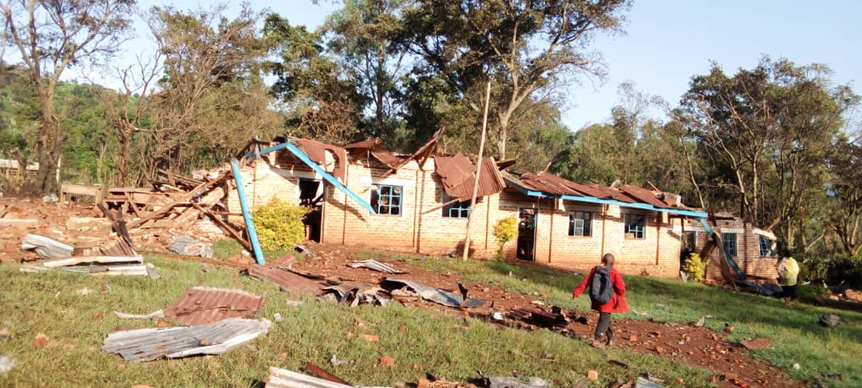
Recently, schools have been seriously affected, including the Munanira Primary School in Kalehe, South Kiva, which was bombed on 12 February 2025 (see photo).

School building with one end derelict and the roof fallen in. A chid with a backpack walks in front.

Munanira Primary School, bombed on 12 February 2025

507 schools are closed in Kalehe territory in South Kivu, including 6 kindergartens, 325 primary schools and 176 secondary schools, affecting a total of 35,700 students aged between 5 and 16 years old.

Too little attention is paid to the communities affected by this conflict. Not enough is being done to ensure respect for international humanitarian law. The human rights of people with disabilities are almost forgotten. We need a lasting peace.

We call on all EENET readers around the world to speak out about the situation in the DRC and to help us defend our learners with and without disabilities, their teachers, families and communities.

To learn more about Renaissance Africaine, RENAFKIVU, email: renafsudkivu@gmail.com


Menaces sur l’éducation inclusive en RDC

ONG Renaissance Africaine RENAF, Bukavu, Sud-Kivu

Notre organisation s’engage à soutenir le développement de l’éducation inclusive, en particulier en soutenant l’inclusion scolaire des apprenants handicapés. Nous souhaitons voir le système éducatif réformé, avec des environnements d’apprentissage accessibles, des systèmes flexibles et des enseignants bien formés et inclusifs. Pourtant, nos efforts et ceux de tous les autres acteurs de l’éducation sont contrariés par un conflit qui ne reçoit pas suffisamment d’attention à l’échelle mondiale.

Le Comité international de secours estime que plus de 7 millions de personnes ont été déplacées en RDC. Ce chiffre comprend  2,8 millions de personnes déplacées du Nord-Kivu (où se sont concentrés les récents combats).

Les familles déplacées ont été contraintes de se déplacer vers Goma et le Sud-Kivu, où les communautés d’accueil ont déjà du mal à subvenir à leurs besoins.

Depuis des années, le système éducatif du Nord et du Sud-Kivu est perturbé par le conflit armé qui perdure. Ce conflit a détruit les infrastructures scolaires et communautaires, limité la sécurité des déplacements, interrompu les services de santé et autres services sociaux et aggravé la pauvreté.

Bien entendu, la crise climatique actuelle (sécheresses et inondations) aggrave encore l’impact du conflit.

Outre l’augmentation générale du travail des enfants, le recrutement forcé dans les groupes armés est monnaie courante, touchant de nombreux enfants et jeunes qui devraient être scolarisés. On observe également des niveaux inquiétants de violences sexuelles contre les adultes et les enfants, et les survivants traumatisés ne bénéficient quasiment d’aucun soutien psychosocial.

Maintenir et construire un système éducatif pour tous dans ces conditions est presque impossible. Humanité et Inclusion a récemment signalé que son entrepôt à Goma, où elle stockait du matériel et des provisions pour ses ONG partenaires œuvrant dans le domaine du handicap, a été pillé.

L’afflux récent de communautés déplacées au Sud-Kivu rend l’accès à l’éducation pour tous plus difficile que jamais. Dans certaines communautés, plus de 50 % des élèves sont issus de familles déplacées. De nombreux enfants, handicapés ou non, ne sont pas scolarisés et il n’existe aucun moyen global de les identifier, et encore moins de leur fournir un soutien éducatif approprié.

L’État et la communauté internationale ne font tout simplement pas assez pour résoudre la crise de l’éducation en RDC.

Récemment, les établissements scolaires ont été gravement touchés dont l’Ecole Primaire Munanira à Kalehe  bombardée ( voir sa photo en annexe) au Sud Kivu 12 février 2025.

School building with one end derelict and the roof fallen in. A chid with a backpack walks in front.L’Ecole Primaire Munanira bombardée le 12 février 2025

507 écoles sont fermées en territoire de KALEHE au Sud Kivu dont 6 écoles maternelles, 325 écoles primaires et 176 écoles secondaires ayant au total 35700 élèves dont l’âge varie entre 5 à 16 ans.

On accorde trop peu d’attention aux communautés touchées par ce conflit. On ne fait pas assez pour garantir le respect du droit international humanitaire. Les droits humains des personnes handicapées sont presque oubliés. Nous avons besoin d’une paix durable.

Nous appelons tous les lecteurs d’EENET dans le monde à s’exprimer sur la situation en RDC et à nous aider à défendre nos apprenants avec et sans leurs capacités, leurs enseignants, leurs familles et leurs communautés.

Pour en savoir plus sur Renaissance Africaine RENAF, envoyez un courriel à : renafsudkivu@gmail.com


Let’s make Official Development Assistance to disability-inclusive education count

Nafisa Baboo (former CBM Global Advisor for Inclusive Education) and Ingrid Lewis (Enabling Education Network Director) summarise CBM’s investigation into the state of Official Development Assistance relating to disability-inclusive education. May the findings ignite a sense of urgency and inspire you to use your voice to demand more and better use of ODA to ensure the right to inclusive education.

Read the full report.

Text: Policy Brief: Let’s make Official Development Assistance to disability-inclusive education count. Images: CBM logo. Photo of girls smiling, using sign language. Two girls wear glasses.

Introduction

Funding is being squeezed across all continents and sectors, so it is no surprise that funding for education is declining. Millions of children, including 240 million with disabilities, are denied the opportunity to benefit from education. Without tangible, focused investment, we cannot reduce this number or deal with the additional challenges to education caused by climate crises, conflict and the digital divide. Investment in disability-inclusive education falls far short of the level needed to achieve United Nations Sustainable Development Goal 4 (SDG 4), meet the needs of the 15% of learners who have disabilities, or support systemic reforms such as improving teacher training.

Existing and new education funding actors need to commit to a process that accelerates rather than stifles positive change. It is important that we understand the role Official Development Assistance (ODA) plays or could play in this process. As we approach the third Global Disability Summit, we are counting on tangible commitments from world leaders to make inclusive education a reality for girls and boys with disabilities.

The disability policy marker

In 2018, the Organisation for Economic Cooperation and Development’s Development Assistance Committee (OECD-DAC) introduced the ‘disability policy marker’ within its publicly available Creditor Reporting System (CRS). This non-compulsory marker monitors the extent to which ODA aims to be inclusive of persons with disabilities. DAC members can track their projects on a scale from 0 to 2:

  • 0 (‘not targeted’) means there is no disability inclusion focus;
  • 1 (‘significant’) means inclusion and empowerment of persons with disabilities are significant but not principal objectives in the project or programme;
  • 2 (‘principal’) means that inclusion and empowerment of persons with disabilities are the principal objectives and integral to the design and expected results.

Which donors were assessed?

The investigation first listed the top 20 bilateral donors and then removed those not using the disability marker for at least 50% of their projects. This removed Belgium, France, Germany, Hungary, the Netherlands, Poland and the USA. That means the top three bilateral donors (2021–2022) – Germany, the USA and France – were automatically excluded from the analysis, revealing that a significant share of education ODA is not marked at all regarding disability inclusivity.

The investigation focused on the remaining donors, Austria, Australia, Canada, Denmark, Finland, Italy, Japan, Korea, Norway, Spain, Sweden, Switzerland, and the United Kingdom, plus EU institutions as the only multilateral currently using the disability inclusion marker.

Findings

CBM’s investigation used evidence from the disability policy marker to see whether and how ODA is helping or hindering progress towards inclusive, quality education. Data was drawn from 2019 (the first full year of data) and 2022 (the latest full year available).

  1. Disability-inclusive education remains underfunded by donors

In 2022, DAC members disbursed almost $11.5 billion in aid. The data revealed that only 14% of this aid (just under $1bn) aimed to be disability inclusive and less than 1% was marked with disability inclusion as a principal objective. A third of aid had no disability inclusion objectives. More than half of education ODA did not have the voluntary disability policy marker applied.

Between 2019 and 2022, there was no change in the percentage of education ODA marked with a principal disability objective and only a small increase in the aid marked as having a significant disability objective (from 13.2% to 14.5%).

  1. Donor performance varies greatly

Donors varied in the share of their ODA that had disability inclusion objectives (e.g., Sweden 66%, Canada just over 50%, EU 38% and Norway just under 30%). The picture changes significantly when looking at the volume of aid. Here, the EU disbursed by far the largest volume of education ODA with disability-inclusive objectives (almost $400m).

  1. Donors using the marker are getting better over time

Among DAC donors who currently use the marker, their use has noticeably increased since 2019. Denmark and Canada, for instance, went from not using the marker at all in 2019 to using the marker on 100% and 92%, respectively, of their education aid in 2022. At the time of CBM’s study, Germany had not submitted data, but it is now applying the marker. Disability marker users also showed increases in their share of disability-inclusive education ODA in this period, except for the UK.

  1. Key issues in education need more attention

Early childhood education (ECE): This remains vastly underfunded and falls behind in disability inclusivity. From the aid disbursed to ECE in 2022, only $1.8 million scored 2, and only $12.3 million scored 1 on the disability marker. This represents just 0.1% of all allocable aid disbursed to education in 2022, and around 1.5% of all aid to education which aimed to support the inclusion of persons with disabilities.

Organisations of persons with disabilities (OPDs): Supporting OPDs enables persons with disabilities to engage in the development of inclusive policy and practice. However, word searches of the disability marker data revealed that only Ireland, and to a lesser extent Italy and Japan, supported projects with a principal objective of helping the inclusion or empowerment of disabled persons through core support to NGOs, although not necessarily DPOs.

‘Do no harm’: The principle of ‘do no harm’ is only a recommended programme principle in the OECD-DAC handbook on the disability inclusion policy marker, meaning it is not an explicit requirement in the marker. This leaves the door open for exclusionary or discriminatory practices such as special schools or segregated education to go undetected whilst gaining a score of 1 or 2 in the marker.

Systemic change: No DAC aid disbursed in 2022 supported the principle aim of inclusion for sector budget support. Only the EU had any projects in this category. Sector budget support helps a recipient government with sector-wide change to the public education system – something they urgently need to do to ensure education becomes disability inclusive. It is worrying that so little donor support focuses on an area that might enhance systemic change.

Recommendations

  1. Reach: Expand the use of the disability marker across all donors, including multilateral donors.

  • All bilateral donors need to start using the marker. Those currently not using it should set a timetable for its introduction into their systems.
  • Multilateral donors other than the EU need to start using the marker. UNICEF, with its own marker already in place, should show leadership in this area.
  • Donors already using the marker should work towards 100% of their ODA being marked.
  1. Quality: Improve the quality of the marker

  • The disability policy marker should move from voluntary to mandatory in the next two years.
  • The introduction of a negative mark should be considered to enable the marker to capture evidence of education projects that do not uphold the ‘do no harm’ principle (e.g., projects that increase exclusion or segregation and arguably ‘do harm’).
  • DAC should introduce a purpose code in the marker relating to support to OPDs, bringing more focus to participation and leadership by persons with disabilities.
  1. Purpose: Increasingly use the marker to promote inclusive education

ODA needs to embrace the twin-track approach, supporting both disability-specific and system-wide actions towards inclusion. Increasing the share of funding allocated to education projects that score significantly or principally on the disability marker is a vital step in achieving this. Projects where disability inclusion is principal will help redress historic and pervasive exclusion in areas such as bilingual education and literacy for Deaf and hard-of-hearing students, capacity development of specialist teachers, the empowerment of youth with disabilities and OPDs, and research.

  • All donors should set the target of 50% of their education ODA receiving a positive disability marker score.

Final thoughts

The futures of millions of children with disabilities depend on us taking action now to invest in disability-inclusive education. ODA plays a vital role in building this future in which no one is left behind, which is why we need a concerted effort to improve and increase education funding. We need consistent investment, with clear, ambitious and rigorously measured disability inclusion targets. We need all governments and all donors to get on board, embrace the use of the disability policy marker, and support its constant development and improvement. We need education ODA to really mean something for children with disabilities in low- and middle-income countries.

Read the full report.

Call for Articles: Enabling Education Review, Issue 13

**Deadline extended to 31 October 2024.**


Information and communication technology and other assistive technologies have the potential to impact social and educational inclusion so the theme for Issue 13 of Enabling Education Review will be:

“Inclusive EdTech”

The deadline for submitting first drafts of articles is 30 September 2024. Details of suggested topics and how to submit articles are provided below.

Contact info@eenet.org.uk with any questions.


1. Why have we chosen this topic?

Increasingly, Education Technology or EdTech is used to support the educational inclusion of children with and without disabilities, including those who are neurodiverse or have other learning difficulties. EdTech is used to describe the combination of computer hardware, software (or information and communication technology and assistive technology) with educational theory and practice to facilitate learning for education purposes. As such, EdTech can complement face-to-face inclusive pedagogy and enable inclusive remote teaching and learning, both at the school level and in teacher training.

ICT and assistive technology innovations in distance education grew during the COVID-19 pandemic but were often not made accessible and did not benefit everyone. EENET’s own survey of home learning in 2020 showed that children with disabilities, children in low-income settings and other marginalised groups of learners were more likely to be excluded as digital innovations advanced. Existing inequalities were made worse.

To help meet the Sustainable Development Goal of ensuring inclusive and equitable quality education for all learners, we need to reflect on how ICT can be made more affordable, appropriate and accessible. We need to explore the challenges and opportunities of using ICT and other assistive technologies within inclusive education in low- and middle-income contexts. We cannot say that ICT is too expensive and will never be used in poorer contexts. Rather we need to ask: How can it become a viable and valuable tool in the inclusive education toolbox for every country? And, in using the phrase Education technology (EdTech) we recognise that providing the technology on its own is only a partial solution at best, and often a missed opportunity.

2. What could you write about?

This issue of EER will explore how ICT and assistive technologies can be used to support learning and teaching in inclusive settings. There are many aspects of EdTech that you could write about, including but not limited to:

  • How have approaches to teaching and learning changed and become more inclusive because of the use of ICT?
  • How were ICT and other assistive technologies used to support learners transitioning back into schools after COVID-19 closures? What could this tell us about using ICT and assistive technology to support other educational transitions?
  • As a learner, how has the use of EdTech impacted your educational experience?
  • As a teacher, how have you reached and supported all your learners using EdTech? What challenges and opportunities have you experienced? Who has helped you?
  • What impact does the accessibility or inaccessibility of ICT and the use of assistive technology have on peer-to-peer relationship in classrooms?
  • How are teachers trained to use ICT and assistive technologies? How are their trainers trained? What professional development programmes are most effective and what else is needed?
  • What has worked well in financing the adaptations and use of ICT and assistive technology in inclusive settings in low- and middle-income contexts? What has worked well in sustaining the use of ICT and assistive technology?
  • What policies and regulatory frameworks support the integration of EdTech in inclusive education?
  • How have you advocated at the local or national level for better or more inclusive digital approaches to education?
  • How have you developed partnerships to coordinate the effective use of EdTech in inclusive education?
  • How have you motivated or supported a strong political commitment to using EdTech in inclusive education?
  • How have you used EdTech to support learners who learn at home on a regular basis? What innovations or changes emerged from the experiences of widespread home learning during the COVID-19 pandemic?
  • How has the use of EdTech affected the mental and/or physical well-being of learners, parents, families, and teachers? What has been done to support them?
  • How can Artificial Intelligence (AI) help to create more inclusive learning environments? What advancements have already happened and what opportunities are around the corner? What are the benefits, challenges and risks?
  • How will the advancement of Artificial Intelligence (AI) impact inclusion of learners with disabilities in education?
  • What lessons have we learned that could improve the use of EdTech in the design and inclusivity of education systems long term?

Enabling Education Review helps people share and learn from each other’s experiences. Therefore, we welcome articles that offer practical insights to help others looking for ideas that they can adapt and try. We like articles that provide a little background to the context, project or programme and then explain the activities that happened (what, where, when, with or by whom, and why). We also like to read about the results, if possible.

3. How can you submit an article?

Please email your article to info@eenet.org.uk or send a hard copy to the address at the end of this document.

Authors can write in English or their preferred language.

Length – 550 words (for a single-page article) or 1,100 words (for a double-page article). We may edit longer articles down to a single page, depending on the quantity and quality of articles received.

Style

  • Write an article: please keep the article easy to read and non-academic. We encourage the use of sub-headings, bullet lists, simple diagrams, etc. Have a look at previous editions of the publication if you are not sure what style to use: www.eenet.org.uk/enabling-education-review/
  • Write a poem: we encourage you to be creative with your submissions, so if you prefer to write a poem rather than an article, that’s great.
  • Present a drawing: if you feel that the story you wish to tell is better told visually, please feel free to submit a picture rather than an article. Please give your drawing a title. You could also write and submit a shorter piece of writing that explains the drawing.

Editing – we are happy to help edit the article, so don’t worry if you are not an experienced writer. We can work with you to improve the structure and content of your article, make it shorter/longer, etc.

Working in audio – if you would like to send us a voice recording of your article or be interviewed as the basis for an article, please contact Su Corcoran at info@eenet.org.uk to discuss options.

Photos – it is great if you can add photos, drawings or diagrams to your article. When selecting photos, please look for the following:

  • Active images – e.g., children learning in groups, children playing, teachers/ parents working with learners, and so on;
  • Images that are not too dark, blurred, or pixelated.

Please send us high-resolution images by email (these should be at least 1MB in size), or post us an original print/drawing. For every image you want to add to your article, you will probably need to remove about 75-100 words of text – but we can help with this editing.

Permission

Please ensure that the people in any photos have given their permission for the photos to be published, or that parents/guardians have given permission for photos of children or vulnerable adults to be used.

Please fill in and send us the permission form attached to your photo(s).

Deadline – the first deadline for draft submissions is 30 September 2024. We will then review all articles and work with the authors to edit them.

Selection – please note that we might not publish all of the articles we receive. In addition to ensuring that we publish articles that are easy to read and of practical use to a range of education stakeholders, we will also ensure that the final selection includes:

  • articles from a variety of countries/regions;
  • articles about a range of different issues;
  • articles by authors from different backgrounds.

Articles not selected for publication in EER may instead be published on EENET’s website (www.eenet.org.uk).

Queries – if you have any questions, please email info@eenet.org.uk.

Postal address – if you want to send an article in hard copy (e.g., printed or as an audio file on a flashdrive), please send it to:

EENET

PO Box 422

Hyde

Cheshire, SK14 9DT,

UK

The Destruction of Gaza’s Education System: A Generation at Risk

Ayman Qwaider, EENET’s Arabic/MENA Network Manager.

Read this article in Arabic.

Scale of destruction

The genocidal war in Gaza has left no aspect of life untouched. One of the most devastating impacts is on the education system and, consequently, on the future of Gaza. The damage being inflicted will have profound and long-lasting effects on the current and future generations in Gaza. While much has been written about the overall impact of the war, the systematic destruction of Gaza’s education sector deserves particular attention.

Schools, both public and those operated by the United Nations, have been reduced to rubble. Universities, which once served as the backbone of higher education in Gaza, lie in ruins. The very institutions where generations of teachers were trained have been obliterated. Alongside the destruction of formal education facilities, community education centres, art centres, and archives – essential components of cultural and educational life – have also been destroyed. Many of these learning spaces have been converted into shelters for displaced families, underscoring the sheer scale of devastation.

This is not merely the destruction of buildings; it is the dismantling of an entire educational infrastructure. Teachers have been killed, their families displaced, and their schools and universities destroyed. Every household in Gaza has been touched by loss, through the death, disappearance, or separation of loved ones. The images of bombed homes, displaced families, and the daily struggle for survival have dominated social media for months, revealing only a fraction of the suffering that continues unabated.

One cannot overstate the impact of this destruction on education and learning. The cumulative trauma, suffering, and memories of violence experienced by an entire generation are staggering. The children of Gaza, exposed to unprecedented levels of violence and abuse daily, face a future where education is inextricably linked to their trauma.

What happens next?

The question now is: What will education/learning look like in Gaza after this? How can learning continue amid such accumulated trauma and suffering? The psychosocial trauma inflicted on Gaza’s children, teachers, and families has been accumulating over the last 17 years, exacerbated by the continuous Israeli blockade and repeated military assaults. This current unprecedented violence only adds another layer of pain and suffering.

To address these challenges, psychosocial support must be integrated into any educational interventions. Every person in Gaza will need such support, and this must be sustained over a long period. Schools and curricula will need to be re-engineered to meet the needs of these traumatized learners. The curriculum must be informed by the experiences of those who have lived through this trauma, and teaching pedagogy must evolve to capture and address the stories of these children.

Educators themselves will need significant support – socially, culturally, and psychologically – to process and share their experiences. It is vital that they have the space to tell their stories, not just for their own healing but also to inform the world of the realities of life in Gaza. No one should endure genocide without the opportunity to bear witness, and the stories of Gaza’s educators and students are essential for understanding the true cost of this conflict.

The loss of an entire year of education in Gaza is unprecedented. For the first time since 1948, Palestinian students in Gaza were unable to complete their higher education exams, and children were deprived of the opportunity to pursue their dreams. The destruction of Gaza’s education system is not just a loss for the present generation but a profound threat to the future of the entire region. The rebuilding of this system will require more than just physical reconstruction; it will require a reimagining of what education can and should be in the context of ongoing trauma and adversity.

Learning about and from genocide

When talking to friends and colleagues in Gaza, a common sentiment arises: there is much written about genocide, yet not enough is done to integrate this harrowing reality into education. They argue that the experience of genocide should not be relegated to history books alone but must be a vivid memory in the minds of education policymakers. It is crucial that education policies reflect the need to address the impact of genocide, and this should be an integral part of the curriculum.

Incorporating the realities of genocide into the curriculum is not merely about recounting the past but about raising awareness and fostering resilience in the present. It is about ensuring that the next generation understands the gravity of such atrocities and is equipped to recognise and respond to the early signs of genocidal actions in the future. For the children of Gaza, who have lived through a genocide, this is not a distant lesson from history but a lived experience. Integrating this into their education could play a vital role in healing and empowerment. Indeed, all parties, locally and globally, need to integrate genocide education into their curricula if we are to prevent such horrors from occurring again.

Educational genocide is part of a broader genocide targeting human life itself. Education’s mission is to uphold human life as the ultimate goal. In Gaza, resilience, or Sumoud, is not just a concept but a lived reality. The people of Gaza demonstrate social solidarity by supporting one another despite unimaginable circumstances. Conventional education is insufficient; it must evolve into learning through life and daily challenges. The future of education in Gaza requires transformation, moving beyond formal schooling to seek opportunities in adversity. This educational endeavour is not just a duty but a form of resistance against a comprehensive genocide that seeks to erase existence and identity.

The hope is that embedding the lessons of genocide into the curriculum will not only educate but also serve as a powerful reminder to the global community. It can be a tool to ensure that such atrocities are not forgotten and do not go unchecked when they occur. Education has the potential to be a safeguard, raising awareness about the devastating impact of genocide and fostering a commitment to preventing it in the future.


Please follow and share EENET’s Hear Us See Us campaign on our website, Facebook and LinkedIn. The campaign shares the experiences of educators and learners in Gaza. We add our voice to the calls for a permanent ceasefire in Gaza and an end to Israeli occupation and apartheid.


#CeaseFireNow

#StopArmingIsrael

#FreePalestine

#EndTheOccupation

#EndIsraeliApartheid

#LearningNeverStops

Supporting Students in Gaza

By Dr. Mohammed Awad Sabhair

This blog is a slightly adapted transcript of a podcast – episode 2 of EENET’s “Inclusive Education: Unheard Stories” series. The podcast is available in Arabic.

 Watch on YouTube.

Listen on SoundCloud.

Head and shoulders photo of Dr Sabhair

Introduction

I am Dr. Mohammed Awad Sabhair, a volunteer activist in the educational community. I hold a Ph.D. in Educational Administration, a Bachelor’s degree, and a Bachelor’s degree in Psychology. I work as a director and a distinguished school supervisor at Al-Aqsa University in the Gaza Strip. I am actively involved in the Arab and global campaigns for education for all and the Palestinian Educational Coalition.

I am also the founder of the Pulse of Peace Association for Mental and Community Health, a mental health first aider in times of crisis, and a certified educational and community trainer within the Gaza Strip. I am involved in various civil, private, and popular voluntary institutions. I am a member of the Community Accountability Committee in Gaza and a researcher with numerous published research papers, studies, articles, and diverse writings locally and regionally.

My current situation

I am in Khan Yunis Governorate, southern Gaza. We were told by the Israeli forces to evacuate our homes due to the precarious situation. We find ourselves in a dire situation, facing inhumane conditions with a complete lack of services. The harsh winter conditions surround us. This area is also close to the Rafah border, where over a million and a half people are cramped in a small space, lacking essential services.

There are insufficient words to describe the scene in the displacement area where my family and I are located. It is almost impossible to convey the complete picture. We are experiencing power outage for over three months, no communication or internet services due to the destruction of the communication network. There is a complete lack of water services due to the destruction of underground networks. We resort to primitive methods to obtain and transport water.

Transportation services are entirely halted, fuel is scarce, and essential goods are absent. If available, prices have skyrocketed. Special medications for children, women, the elderly, and pregnant women are unavailable. People are suffering with difficult health conditions. There is a shortage of basic goods, and tents, blankets, and winter clothes are unavailable. The local stock of water, livestock, crops, and goods is depleted due to the lack of entry of supplies.

4 very thin flatbreads on a hot plate. A woman's hand holds another piece of flattened dough.

Living under siege

Daily life is severely impacted by the complete closure of land crossings, a comprehensive naval blockade, full control of the airspace, and continuous airstrikes and destruction throughout the day. As night falls, fear and anticipation take over, and in the pitch-black darkness, movement becomes impossible due to reconnaissance aircraft hovering above.

The continuous shelling of coastal areas by naval vessels adds to the danger. As I write this message, the sound of shelling intensifies. In the face of these conditions, we are lost, not knowing where the circumstances will lead us or how to meet the needs of our families and children.

My children, who now ask questions and engage in discussions, are met with silence from us adults in the face of the crisis and the catastrophe we are living through day and night.

Concrete buildings destroyed by bombing

 The education situation up to October 2023

Around 650,000 students were enrolled in education in Gaza. Supervision of education was shared among the Ministry of Education, the Palestinian Education Authority, the UN Relief and Works Agency (UNRWA), and private schools. In Gaza, before this war, 750 schools were operating on a two-shift system due to the high student density. The political division imposed by Israel since 2007 led to a comprehensive blockade affecting all aspects of life until 2023. This has caused significant destruction in all areas, particularly in education.

The conditions for teachers and educational staff were extremely challenging. They did not receive their salaries regularly, and delays in payment led to a loss of motivation, forcing them to seek additional employment to meet their needs. The severe poverty and unemployment experienced by parents also affected students, as many parents were compelled to send their children to work to support their families.

A mound in the earth, with a cardboard sign - probably a grave

The impact of war on education

Then came the latest war on Gaza in October 2023, where Israel terminated all agreements, treaties, and conventions calling for the protection of the right to education and the preservation of educational institutions and facilities without harm or disruption. As of now, the education sector has reached a point of complete destruction and collapse due to Israeli practices, including the brutal and genocidal war.

The numbers attest to the difficult situation: 4,119 students have been killed and 75,000 students wounded. Additionally, 221 teachers and administrative staff working in the ministry have been killed and 703 injured. Furthermore, 83 schools have suffered severe damage, seven schools have been completely destroyed, and 278 schools require major maintenance. Also, 65 schools affiliated with UNRWA have been damaged. The Ministry has indicated that 90% of school buildings have been directly or indirectly damaged.

All schools in Gaza – whether under the Ministry of Education, UNRWA, or private institutions – have been turned into shelters for displaced people fleeing Israeli attacks. The situation is dire, with schools that were once able to accommodate 2,000 students now housing 9,000 displaced individuals. Other schools have been subjected to theft, vandalism, and looting of school furniture, which is sometimes used as fuel for cooking due to the lack of fuel and cooking gas.

There has been direct targeting, arrest, and displacement of many people, including those managing the shelters. In light of these figures and this grim scene, the education sector in Gaza has reached a point of complete destruction and collapse. No local entity can provide any services for education in the near or distant future without a halt to the war and the intervention of a state to rebuild the education sector, including schools, universities, and kindergartens.

Supporting students

Students have developed psychological symptoms, manifested in severe fear, constant anxiety, various behavioural problems including involuntary urination, night terrors, withdrawal, intense crying, constant panic, clinging to parents, difficulty sleeping, reluctance to participate in group activities, loss of passion, absence of hope, feelings of guilt, constant self-doubt, and frustration, as well as various health issues and emotional numbness.

Through my work in shelters and displacement centres, I see this vivid reality that we experience every day with the children and their families. We strive to provide first-level psychological and social support services to children and their families to alleviate fear and provide temporary stability. We collaborate with the Teacher Creativity Center to offer socio-emotional learning services to children in shelter centres, helping them stay connected with various educational skills and make up for what they missed during the past three months of the war.

Many children and a few adults playing with a rainbow coloured sheet of cloth and some balls

Several youth and volunteer initiatives and organisations try to provide play services, support, and distribute gifts to children and students to alleviate their suffering. The distribution of some guidance manuals for parents on first aid for psychological care, child protection, emergency education times, and emotional support is ongoing.

What we witness is extremely dangerous and challenging. However, we believe it is our duty to uphold the right to education and learning during emergencies, and to be present to provide humanitarian services to students and children, guiding parents on providing education based on available resources and under difficult circumstances.

A man hoding a ball, with children around him. They are inside a refugee tent.


Looking ahead

Many questions remain unanswered from parents and children. When will the war end? Is there a ceasefire? What happened to my father who was arrested by the Israeli army? Will we return to our school? What about our teachers and classmates who were killed in this war? Where is our home, and in which house? How can we make or find food? I want to buy clothes; we need a tent to live in. Faced with these questions, we stand helpless, as there are no answers to these questions. No countries in the world can answer them in the face of the might and aggression of the Israeli war machine.

Everyone’s hope for a future life has been shattered, as the students reported when asked about their outlook for the future. Their responses were heartbreaking:

“There is no future; the future is gone. There is no hope.”

This is the language of children, and I convey it to you. We stand together to protect our students and keep the flame of their right to education, towards providing sustainable, equitable, and dignified education for all. We will not leave anyone behind due to the atrocities of the Israeli war.

I wish you a day and times filled with hope and peace.

Bande de Gaza : l’enseignement est attaqué

Cet article du blog a été écrit par Ayman Qwaider (EENET’s Arabic/MENA Network Manager), le 7 novembre 2023.

Traduit par Siham Touil.

Les enfants pris pour cible

La moitié des plus de deux millions d’habitants de la bande de Gaza sont des enfants, et actuellement, l’un d’entre eux est tué toutes les 10 minutes. Depuis le 7 octobre 2023[1], les statistiques du Ministère de la Santé à Gaza montrent qu’au moins 4 100 enfants palestiniens ont été tués dans les bombardements incessants de l’armée israélienne. Plus de 1 000 autres enfants sont portés disparus, probablement enterrés sous des bâtiments détruits. Prendre pour cible des civils, en particulier des enfants, constitue une violation grave des Conventions de Genève et est considéré comme un crime de guerre. Les enfants ne devraient jamais être la cible d’un conflit, de part et d’autre. Les enfants de Gaza sont les plus touchés par l’agression israélienne en cours, qui les prive de leurs droits fondamentaux, notamment l’accès à la nourriture, à l’eau, à un abri, à l’éducation, aux soins de santé et à la sécurité.

Une enfance en cage

Aujourd’hui dans la bande de Gaza, aucun enfant n’a jamais connu la liberté. Depuis 2005, le territoire est soumis à de sévères restrictions imposées par Israël, et le blocus s’est renforcé lorsque le Hamas est arrivé au pouvoir en 2006. L’ONU considère Israël comme une « puissance occupante » au sein des territoires palestiniens et le blocus viole le droit international. L’enclave est l’une des zones les plus densément peuplées de la planète (5 850 habitants au kilomètre carré), souvent décrite comme la plus grande prison à ciel ouvert du monde. Depuis 16 ans, l’économie, les infrastructures, l’emploi, les communications, l’éducation et le système de santé suffoquent et les déplacements de la population sont presque entièrement limités. La plupart des enfants n’ont jamais bénéficié de 24 heures d’électricité en continu dans leur vie. Tandis que la catastrophe humanitaire actuelle, extrêmement meurtrière, attire l’attention du monde entier, l’ONU et les agences humanitaires parlent depuis de nombreuses années de la crise humanitaire croissante dans la bande de Gaza et mettent en garde contre les violations flagrantes des droits de l’Homme.

L’enseignement perturbé

Les Gazaouis sont des personnes dynamiques et instruites, rêvant d’un avenir meilleur. Les aspirations de plusieurs générations sont aujourd’hui plus que jamais attaquées. Plus de 625 000 étudiants et 22 564 enseignants de la bande de Gaza ont été touchés par les attaques contre l’enseignement ce mois passé. Les enfants n’ont pas accès à la scolarité et n’ont pas d’endroit sûr où se réfugier. Le Ministère de l’Éducation a annulé l’année scolaire, et 214 écoles ont jusqu’à présent été endommagées par les bombardements, parmi lesquelles 45 sont entièrement hors service. Des enseignants ont été tués dans les bombardements.

Alaa Qwaider, une mère aimante, a été tuée dans sa propre maison, détruite lors d’une frappe aérienne israélienne. Cette attaque dévastatrice a également coûté la vie à ses trois jeunes enfants : Eman, tragiquement tuée le jour de son cinquième anniversaire, Faiz, quatre ans et la petite Sarah, âgée de sept mois seulement. Quatorze autres membres de sa famille ont été tués dans la même frappe aérienne, ne laissant en vie que le mari d’Alaa.

A headshot of Alaa Qwaider smiling at the camera wearing a black and white spotted headscarf.

Alaa n’était pas seulement une mère. C’était aussi une professeure de mathématiques très respectée dans son lycée à Gaza City. Elle était très fière de sa carrière et de sa mission importante consistant à enseigner auprès des jeunes. Elle partageait souvent avec moi (Ayman Qwaider, auteur de l’article, est son frère) des photos de ses réalisations. Son dévouement à l’enseignement était évident dans ses interactions avec ses étudiants qui la tenaient en haute estime pour son implication dans leur scolarité. Alaa connaissait le contexte de vie de ses élèves – vivre sous blocus pendant 16 ans au sein d’un régime d’apartheid[2] et être témoin d’opérations militaires régulières – et l’impact sur leur apprentissage et leurs besoins émotionnels. Elle recherchait activement des opportunités de formation et de développement de ses compétences pour mieux soutenir ses étudiants, en particulier ceux qui avaient été exposés à un traumatisme.

Le Ministère de l’Enseignement supérieur rapporte que 437 de ses étudiants et 12 membres du personnel universitaire ont été tués au cours des trois premières semaines de cette guerre, dont 85 % à Gaza City. On craint que de nombreux autres étudiants soient ensevelis sous les décombres. La scolarité de près de 90 000 étudiants de l’enseignement supérieur est perturbée, les universités ayant été contraintes de suspendre toutes leurs activités. Une université de Gaza a dû annuler son année universitaire 2023-24 en raison de la perte de tous ses étudiants dans les bombardements israéliens.

Un cinéma pour les enfants de Gaza et une pédagogie adaptée aux traumatismes

Jusqu’au 7 octobre, le projet Gaza Children’s Cinema (GCC) a fonctionné dans les bibliothèques locales à travers la bande de Gaza, en partenariat avec l’Institut Tamer pour l’éducation communautaire. Le GCC avait concentré ses activités sur les communautés marginalisées et frontalières (avec Israël), s’adressant aux enfants les plus isolés. Malheureusement, ces communautés frontalières sont particulièrement vulnérables face aux destructions des forces israéliennes, notamment lors d’incursions terrestres. Les rapports indiquent que dans toute la bande de Gaza, plus de 200 000 logements ont été soit détruits, soit endommagés, et des dizaines d’installations publiques et de services – telles que celles utilisées par le CCG – ont subi des dommages importants. Le GCC a été justement créé pour offrir des alternatives éducatives et des activités récréatives aux enfants profondément touchés par un traumatisme. Cela leur a fourni un répit temporaire face à la réalité difficile à laquelle ils étaient confrontés. Avant cette nouvelle guerre à Gaza, près d’un enfant sur trois recevait déjà un soutien psychologique. Les bombardements dévastateurs actuels, d’une ampleur sans précédent, ont exposé les enfants de Gaza à des traumatismes encore plus graves et plus durables, avec des conséquences qui persisteront probablement tout au long de leur vie. Mais les programmes vitaux destinés à les soutenir, comme le GCC, ont été anéantis et leur reconstruction pourrait prendre de nombreuses années.

L’UNICEF a déclaré qu’au cours des dernières semaines, « Gaza est devenue un cimetière pour des milliers d’enfants ». Il est impossible de comprendre l’impact de cette situation sur les enfants qui survivent. Les programmes éducatifs pour faire face aux traumatismes devront être un point essentiel de la scolarité dans un avenir prochain. Cela signifie approfondir la formation des enseignants, des éducateurs afin de les doter des compétences nécessaires pour soutenir efficacement leurs élèves. Mais les enseignants et les éducateurs, eux-mêmes traumatisés, auront besoin de beaucoup plus de soutien émotionnel et professionnel pour apporter l’accompagnement nécessaire aux élèves également traumatisés. Cependant, rien de tout cela ne pourra se produire tant qu’il n’y aura pas un cessez-le-feu complet entre les forces israéliennes et le Hamas.

Protéger les droits des enfants

La communauté internationale prend note de cette guerre. Adele Khodr, directrice régionale de l’UNICEF pour le Moyen-Orient et l’Afrique du Nord, la qualifie de « tâche croissante sur notre conscience collective ». L’UNICEF, aux côtés de centaines d’ONG, a également appelé à un cessez-le-feu immédiat pour protéger les enfants de Gaza. Il est crucial que la communauté internationale prenne des mesures immédiates pour protéger leurs droits et leur bien-être : fournir une aide humanitaire et œuvrer en faveur d’un cessez-le-feu durable. Le monde doit s’unir pour garantir que la sécurité, les soins de santé et l’éducation ne soient pas un luxe mais des droits fondamentaux pour tous.

Les étudiants et les enseignants tués à Gaza

Plusieurs milliers d’enfants innocents, leurs familles et leurs enseignants ont été tués à Gaza, non seulement ces dernières semaines, mais au cours des 75 dernières années.

Osama Abu Safia[3] était étudiant en médecine à l’Université Al Azhar de Gaza. Il avait récemment réussi l’examen de la première étape du USMLE[4] et était un bénévole actif, faisant la promotion de l’éducation sanitaire dans les mosquées et les écoles. Son potentiel pour devenir un médecin talentueux dans le futur et ses contributions à sa communauté ont été tragiquement stoppés par une frappe aérienne israélienne sur Gaza.

Osama Abu Saifa smiles at the camera as he leans on a counter. He has his arms crossed and is wearing a blue t shirt. There are trophies on the shelves behind him.

Yasmine Khorshid[5] a été diplômée en gestion des bibliothèques il y a à peine trois mois. Elle a été tuée avec sa famille, ses tantes, ses oncles et leurs enfants dans la ville de Gaza. Plus de 30 personnes de la famille Khorshid ont été tués.

Yasmine Khorshid stands on a podium, smiling and addressing an audience. She is wearing a headscarf and a cap and gown.

Khalil Abu Yahiya[6] a été tué avec toute sa famille à Gaza. Khalil était maître de conférences à l’Université Islamique de Gaza et était largement reconnu pour son génie en tant qu’écrivain, activiste et penseur.

Khalil Abu Yahikya smiles at the camera holding a bunch of flowers and wearing a graduation gown with red trim. over his suit and tie. Behind him is a wood panelled wall with a poster in Arabic.


[1] Le 7 October 2023, le Hamas a tué 1400 Israéliens et a pris en otages plus de 200 personnes, incluant des enfants

[2] See: https://www.hrw.org/report/2021/04/27/threshold-crossed/israeli-authorities-and-crimes-apartheid-and-persecution and https://www.amnesty.org/en/latest/campaigns/2022/02/israels-system-of-apartheid/

[3] https://twitter.com/osaidessermd/status/1719118526168899961?s=46&t=PTHQCFBhd570mEv_M8fiQw

[4] Le United States Medical Licensing Examination est un programme d’examen organisé en trois étapes dont l’objectif est d’obtenir un permis médical aux États-Unis

[5] https://twitter.com/uzisall/status/1719699570010046958?s=46&t=PTHQCFBhd570mEv_M8fiQw

[6] https://twitter.com/fatimazsaid/status/1719165606375641174?s=46&t=PTHQCFBhd570mEv_M8fiQw