Afrida Iqbal
Save the Children (SC) approaches the climate crisis as a child rights crisis. We believe that one of the most effective ways of addressing the crisis is through knowledge, awareness and skills. Hence, to address the unprecedented impact of climate change and environmental destruction on education, SC has, together with the World Wildlife Fund (WWF), developed Green Generation – an inclusive environmental education model. It uses project-based learning to support and promote child-led environmental actions.
“Our education and our future were put on hold as we struggled to survive.“
16-year-old Maryam’s education was interrupted for a month when her family was displaced due to flooding in West Africa’s Sahel region. Hers is just one of several hundred thousand stories globally of climate change impacting children’s education.
It’s why we started Green Generation (GG) in Myanmar, then Cambodia, Syria, Lebanon, West Bank, Guatemala, and soon in Bangladesh, Niger, Norway and Eastern Europe.
What is Green Generation?
GG provides flexible opportunities for children to learn about the climate crisis and local environmental challenges, and participate in and/or lead actions for change. A project-based learning approach supports children’s leadership and active participation. They are encouraged to find answers and solutions for themselves and make active choices.
Project-based environmental education leads to:
- child-led environmental action in schools and communities;
- caring attitudes and sustainable behaviour toward the environment;
- encouraging preservation of natural resources;
- strengthening children’s leadership and crucial skills such as critical thinking, collaboration, communication, and creativity.
The materials
GG has nine contextualised teaching and learning modules for Grades 3-7 focusing on locally relevant environmental and climate change issues. The topics were selected through a consultation process with schools and children. The modules include: Why Nature Matters, Our Forest, Deforestation, Water Consumption and Water pollution, Waste and Litter, Wildlife, Climate Change, Energy and Air Pollution. SC Guatemala developed an extra unit on the effects of climate change on traditional practices and the rights of indigenous people. The modules are available in English, Burmese, Khmer, Arabic, French, Spanish and K’iche’.
Each country used a phased approach:
- contextualising the materials through consultation with children, teachers, community organisations and government representatives;
- training facilitators and teachers;
- piloting the materials with children;
- documenting learning from the pilot and evidence-based advocacy for scale up.
The GG materials include a facilitator guide to support teaching for project-based learning, for teachers more used to teacher-centered approaches. All teachers participating in the initial evaluation highlighted that project-based learning was positive, new and interesting. They said other teachers in their schools were interested in integrating GG teaching and learning materials in their classroom teaching.
Disability inclusion
GG aims to reach and engage children with disabilities. In each participating school, community information sessions promoted the rights of children with disabilities to access education and the relevance of the GG activities. Teachers and school principals were trained to identify children with additional educational needs and better support them using the Student Need Action Pack (SNAP). Consequently, children with disabilities were supported to participate in GG.
Teachers’ views
“Children engage more in identifying environmental issues, solutions, and advocacy within their schools/communities. They feel more confident in decision-making processes, and voice their concerns to community members and local authorities about environmental issues. Child-led initiatives have developed their leadership skills to inspire behaviour change among their peers and adults” (Cambodia)
“We looked for information and content specific to Guatemala. We made the animals specific to Guatemala. We then translated everything to the Quiché/Mayan cosmovision. For example, you don’t play with food (beans, rice, etc.) in Mayan culture, so we adapted to use stones for play activities. So, it wasn’t only a translation.” (Guatemala)
Conclusion
GG is an effective, flexible and adaptable approach for children in all communities, tailored to context, language and culture. With limited funds it can be implemented in any formal or non-formal educational setting. While designed for children, knowledge, awareness and skills trickle down to parents and communities.
Read more about Green Generation:
https://bit.ly/EER13-SC1 and watch videos: https://bit.ly/EER13-SC2.
Ratana’s story, Cambodia
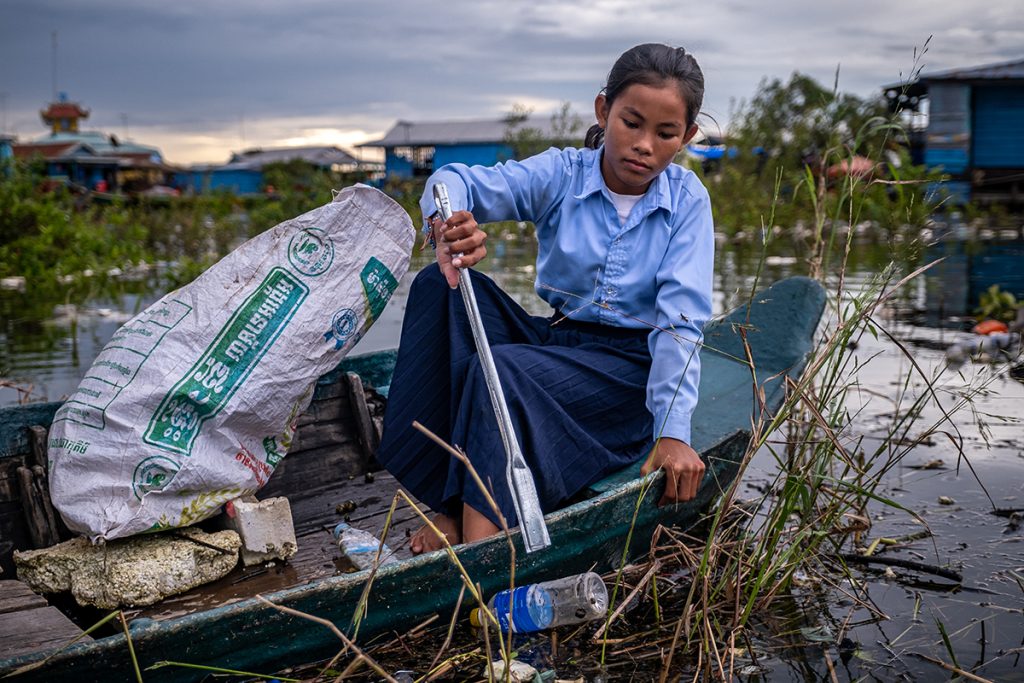
Since 2021, SC Cambodia has implemented GG in 20 schools around Tonle Sap Lake, the largest freshwater lake in Southeast Asia. Tonle Sap is threatened by climate change, dams, and pollution. Its remote, water-based communities are often marginalised. Without infrastructure for waste disposal, they rely on burning rubbish. This affects children’s health and increases the risk that fragile schools will face climate-induced flooding.
Every morning, 12-year-old Ratana travels by boat to a floating school. On the way, she and her friends clear rubbish that litters the lake. They care passionately about cleaning the lake because of the eco lessons introduced into their school’s curriculum. The children identified that water pollution and litter in their community were critical issues for their health and the biodiversity of the lake. They took the initiative, with the help of the school and authorities, to clean up. They dispose of garbage properly and raise awareness among their community and parents.
“I have learned about pollution, deforestation, and garbage [and] how to clean the environment. Adults should listen to children because we are now aware of the environment.”
Afrida Iqbal is an Advisor for Climate Change Adaptation at Save the Children Norway and key contact for Green Generation. Contact:
afrida.iqbal@reddbarna.no or Sine.Christensen@reddbarna.no