
Ingrid Lewis
I wasn’t sure whether I should write this year’s editorial. I’m an editor, I co-edit Enabling Education Review every year, and I know about inclusive education. But I have no environmental qualifications. Shouldn’t we find an ecologist or climate change expert to write the editorial for an edition on inclusive education and climate change? Then I read all the articles again and realised they share an important message. They all show what ordinary people of all ages can achieve when they start making connections between educational inclusion and care for the environment. And I’m one of those ordinary people.
Experts don’t deliver change – we all do
If you’ve followed EENET for some time and read our materials, you will know one of our key messages about inclusive education: “You do not need to be an expert in special needs, disability, gender equality or other specific diversity topics to be an inclusive teacher or to advocate for inclusion. You just need to be interested in and committed to finding ways to improve how we do things.”
This year’s Enabling Education Review articles remind me that the same principle applies in our efforts to prevent environmental destruction and address climate change. There is so much we can all do to support our environment and reverse destructive behaviours – it is not just a task we can leave to the experts.
The problem of nature disconnection
Nature connectedness measures how close a person feels to the natural world. Do they see themselves as part of nature rather than separate from it? How much do they care for and interact with nature and see it as part of their identity? Recent research found that the UK is one of the most nature disconnected countries on earth. Surely it is no coincidence that the UK is also one of the least forested nations in Europe, having failed to prioritise reforestation after centuries of destruction. Nature connectedness and efforts to protect the environment go hand in hand. The more disconnected humans get from nature, the more likely they are to support policies and practices that further destroy the natural world. It is therefore logical to suggest that to save the planet, children and adults need to learn how to reconnect with nature.
My experience at WiseWoods
This year, I have worked with groups of school children at WiseWoods, a neglected woodland my partner and I are restoring in the north of England. The children came for weekly visits as part of their community volunteering activities and helped to:
- clear paths through the woods;
- pull out non-native invasive plants like Himalayan balsam so that rarer, native wildflowers can flourish;
- create dead hedges using dead wood and other green waste (these are boundary fences that re-use material from the land and become wildlife habitats).
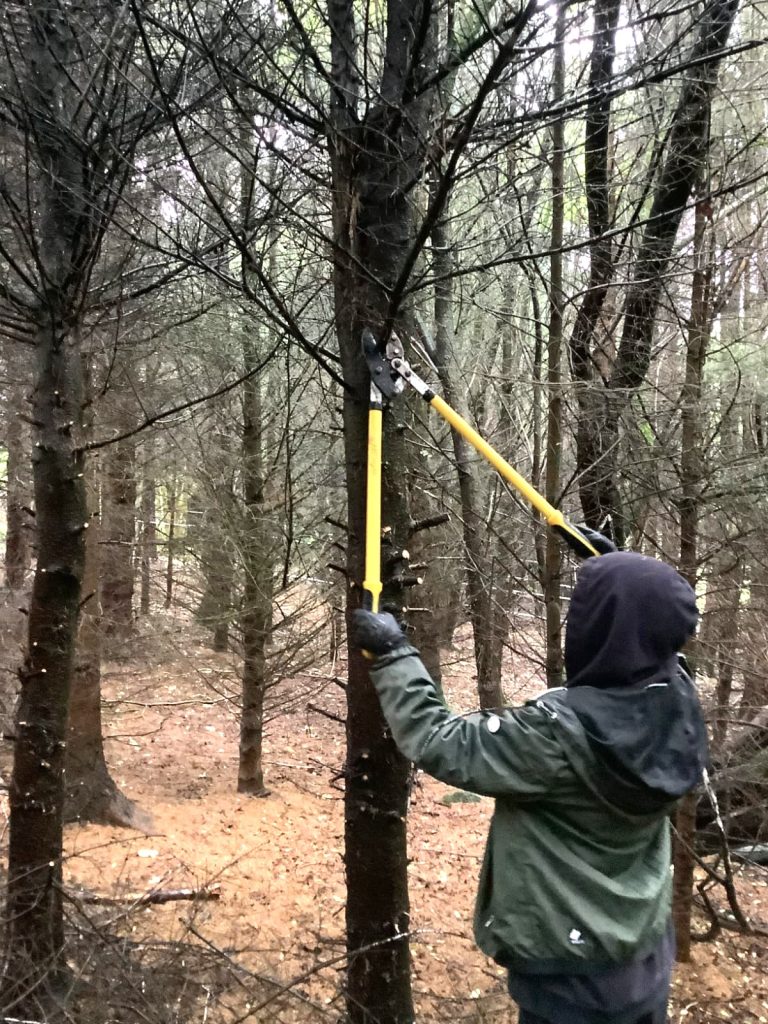
It was great to see some children discover options for nature-focused study or career paths they did not previously know existed. One shared their extensive knowledge of insects and invertebrates, enjoying the chance to discuss something that excited them, but which was not part of the classroom curriculum. But we also had a stark reminder of the gulf between today’s indoor, tech-dominated lifestyles and nature. So many children knew little or nothing about nature (e.g., they were unable to identify a single tree). Many were too scared to touch trees, plants and soil or too worried about getting their hands dirty.
This evidence of nature disconnection on my doorstep heightened my worry about how we will ever tackle the climate crisis. The solutions for our planet are not going to come only from theoretical, clean, indoor science lessons geared towards memorising facts for an exam. And yet it seems that is currently all that most formal school systems have to offer. Where are the curricula that promote nature connectedness? Where are the lessons that enable learners to go outside and practise that connection? And who is making the effort to ensure that learning to (re)connect with nature is accessible for everyone, regardless of their gender, disability and social background?
Recognising the role of power
Of course, even when children and their communities are very aware and connected with nature, other factors constantly undermine the wellbeing of their environments.
Again, EENET’s regular followers will know that ‘issues of power’ underpin our approach to inclusive education. To develop an education system that is inclusive of everyone we must acknowledge and address the power imbalances that cause exclusion. In doing this, the most important realisation is that power is infinite – one person or group can become empowered and included without having to disempower and exclude someone else. This is why much of EENET’s work focuses on supporting systemic change, so that communities and education systems start to address the deep-seated power imbalances that passively allow or directly facilitate exclusion.
Understanding and addressing power is equally vital in our efforts to protect the environment. As J.R.A Williams reminds us in his article on page 16-17, the “excluding values within education – such as hierarchy, consumption, self-interest, power and competition – are the same values we are increasingly understanding as drivers of the climate crisis”.
As humans, we encounter examples of power every day. Most of us easily recognise ‘power over’ (when someone is imposing their power on us). Many of us recognise and maybe strive to achieve ‘power within’ or ‘power with’ – that sense of being empowered as an individual or collectively. But how many of us stop to consider the power that we (humans) are exerting over nature or think about how we could exist alongside nature, without exerting so much power over it?
Escaping the silos
Our attitudes towards power, and entrenched inequality and power imbalances are causing or worsening the exclusion of learners from education and the destruction of our environment. It therefore seems obvious that we should unite our work on improving educational inclusion and protecting the environment. But as yet, this shared effort against a shared problem rarely happens. Why?
The reason is as entrenched as the power imbalances themselves. Policies, programmes and funding too often happen in silos. Government departments for education and the environment do not work together. Donors fund programmes that fit into narrow thematic parameters. NGOs, researchers and governments depend on funding (largely controlled by the world’s powerful elites) and lack the capacity or courage to challenge the donors and demand more holistic support that enables their work to break free of the thematic silos.
From local to global – we can contribute
If we are to fully address educational exclusion and the climate crisis, a revolution is needed in how we advocate for, plan and fund education and environmental work. Each of us can and must play a part in that revolution, whether we’re supporting local changes in our schools and communities or participating in global events to demand change from the world’s policy-makers and money-holders.
What our authors say
The articles in this edition provide exciting insights and ideas for others seeking to combine nature connectedness, environmental protection and inclusive teaching and learning.
The threat to the environment posed by the actions of powerful corporations is highlighted in the article from EarthRights (pages 6-7). Through an education programme that supports students from diverse backgrounds to become activists, EarthRights has enabled fragile communities to harness collective power to speak and act against the environmental destruction caused by mining and industry.
Bringing communities together to take direct action for their environment has also been the goal of Inverdia in Sri Lanka (pages 8-9). However, their community beach clean-up events are also autism awareness events. The approach brings together two interest groups that may never usually meet, boosting their understanding of each other’s issues and enabling more collective action.
The vital conservation role played by community knowledge and practice is highlighted in the article from Kenya (pages 22-23). It also shows how a competency-based curriculum could support the culture and language of an environmentally focused indigenous community.
When a country is in crisis, both its education system and environmental protection efforts are threatened. Recognising this, the Tekkatho Foundation in post-coup Myanmar has developed offline digital libraries that act as community educational and environmental hubs (pages 10-11). These enable learners to continue their education, learn about protecting the environment and develop skills for environmentally sustainable livelihoods.
Connecting inclusive, project-based pedagogy with environmental education is the focus on Save the Children’s Green Generation programme (pages 12-13). It is an approach that boosts learners’ core skills, like communication and critical thinking, while enabling them to take hands-on action to improve their local environment and bring their families and communities into the process.
The article from schools in Wales (pages 18-19) further reminds us that all learners, with and without disabilities, are impacted by climate change and have the right to learn and speak out about it. This article showcases how climate change education and advocacy can be facilitated through accessible, fun, creative and project-based activities.
Listening to children and young people is also the theme of the article from Digital Voices of the Future (pages 20-21). This innovative project uses children’s interest in video games as the stimulus to explore trees and create stories about treescapes, which are then developed into video games. The children’s insights on trees feed into the development of policies for the local environment.
Camilla Chaudhary’s article (pages 14-15) then offers a stark reminder of the threat that environmental damage poses to children’s learning journeys. The article documents the impact that pollution-driven school closures had on learners from different communities in Pakistan. It reminds us that while we must fight ultimately to prevent or reverse environmental crises like pollution, we still need to work out how to support learners whose education is being impacted right now by an unhealthy environment.
The article from J.R.A. Williams (pages 16-17) sums up the urgent need for education systems that help us live peacefully and inclusively together in sustainable, resilient environments. “Making education more inclusive and surviving the climate crisis are two sides of the same coin.”
Share your experiences
EENET would love to share more ideas and experiences on the connections between inclusive education and addressing the climate crisis. Contact us with your stories: info@eenet.org.uk